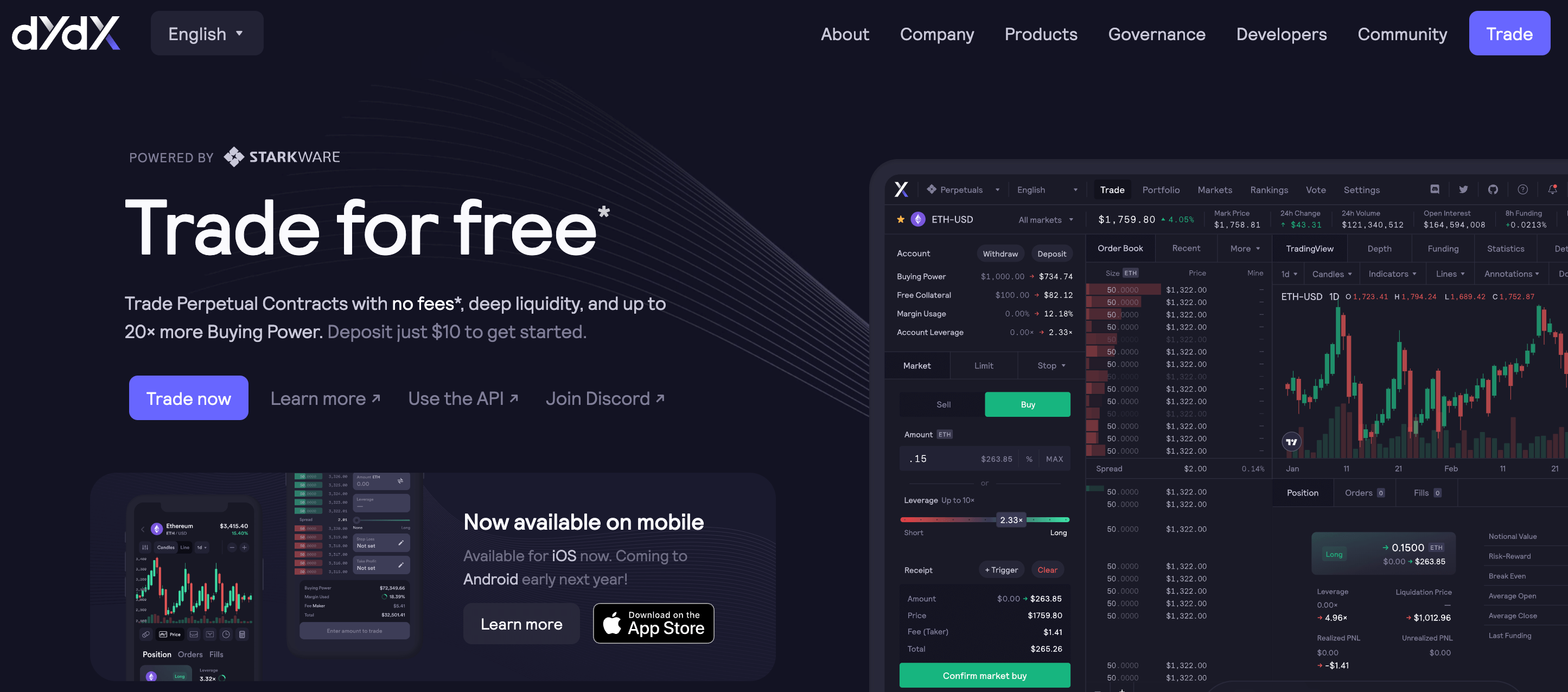
Crypto derivatives have become an inalienable part of the crypto market in recent years. Similarly to the stock market, crypto derivatives can be a great way to speculate on the cryptocurrency’s price or mitigate the losses by hedging.

Choosing the best crypto derivatives trading platform is as important as picking the crypto asset – it can make you rich or broke, depending on the changes in the volatile crypto market. The end-of-2022 FTX drama has shown that investing in profitable cryptocurrency on an unreliable exchange can result in the loss of your earnings. Finding the best exchange to trade cryptocurrency easy since plenty of centralized and decentralized exchanges already support this service. However, it’s not as simple as it looks at first glance. This post discusses the most trusted exchanges worldwide and highlights their vital features. Ultimately, it’s you who makes a decision.

Trading in the derivatives market is riskier and requires more advanced skills than spot trading. Leverage allows you to amplify your earnings tremendously. However, it can also result in much more significant losses than you would have if you just traded with the money at your disposal. Along with the skills and knowledge, finding the best derivatives exchange that will both be safe and give you the resources you need to open up your full trading potential is essential.

Best crypto derivatives exchanges in 2023 – choose a reliable friend for your cryptocurrency journey

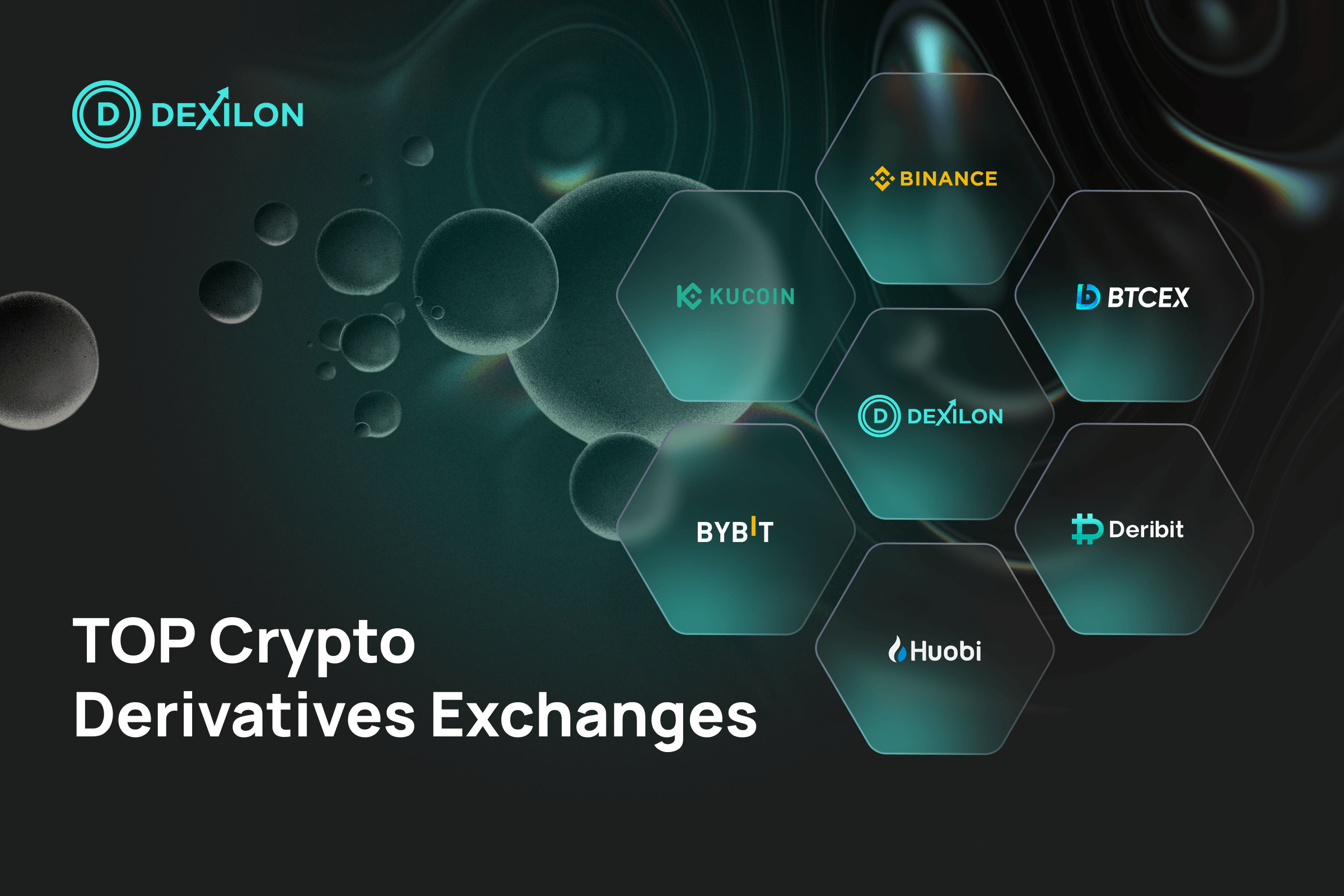
2022 has been rough for crypto, and everyone expects that the 2023 market will still be impacted heavily by everything that happened in the past 12 months. However, some exchanges are doing better than others, especially decentralized ones. Here’s a brief review of the 10 great crypto derivative platforms you can choose from to start (or continue) your crypto journey.

List of TOP cryptocurrency derivatives exchanges

Dexilon
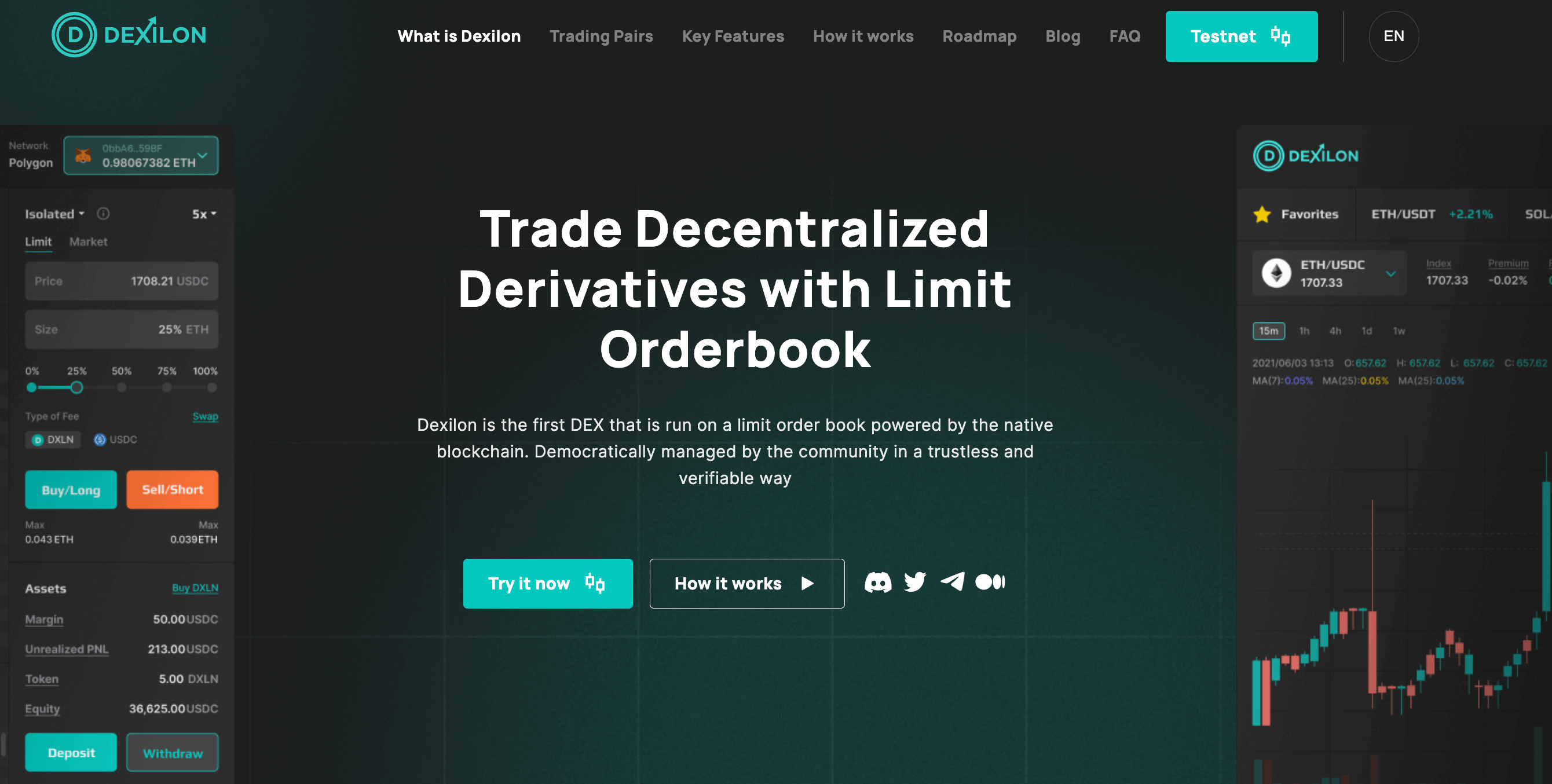
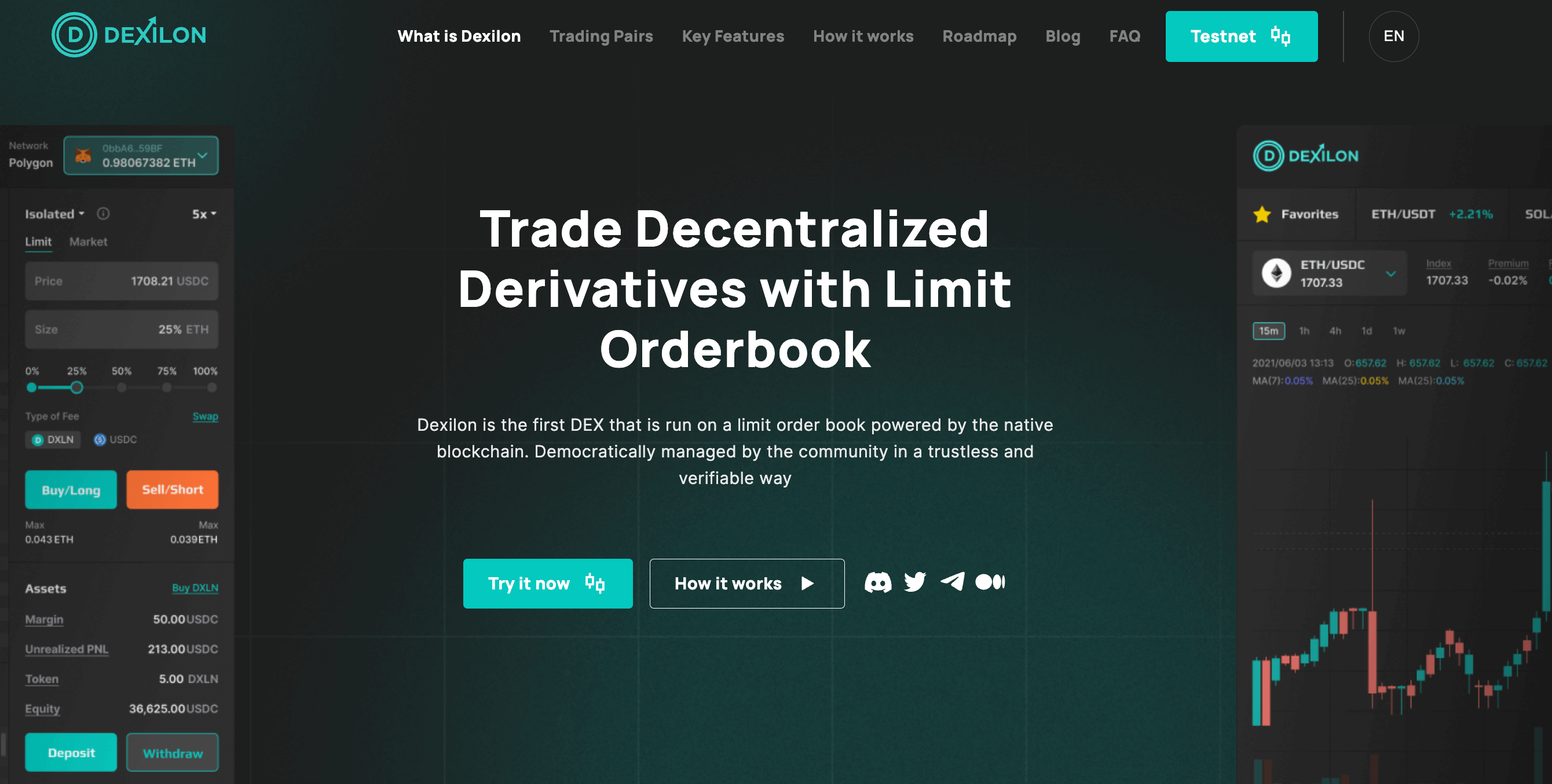
Dexilon is already one of the best cryptocurrency derivatives exchanges even though it has been in the crypto market for less than 2 years. Being a decentralized platform, Dexilon can offer the benefits of the CEXs, like low latency order execution. Dexilon users aren’t paying any gas costs, which makes their low fees even more compelling. With this best crypto derivatives exchange, users are in charge of their assets without worrying about their funds being misused. What is also appealing about Dexilon is their UX – simple and straightforward trading process as well as clear dashboards, which makes it accessible for beginners. Also, their Testnet allows crypto newbies to learn how to trade the best crypto derivatives tokens risk-free.

As for the roadmap, the Dexilon team is building a cutting-edge data terminal to allow users to make informed trading decisions.

Pros

  • Robust security combined with anonymous trading
  • Self-custody – user is in charge of their money
  • Wide range of derivatives to choose from

Cons

  • A relatively short list of coin pairs to trade

Binance

Binance has been on the market for a while and has a vast user base. Binance Futures went live in 2019 and, since then, changed the dynamics of the crypto derivatives industry. The bitcoin derivatives exchange offers USDT-margined perpetual futures, COIN-margined perpetual and traditional futures, leveraged tokens, and BTC options. Trading fees depend on your trading volumes within the past 30 days. The maker fee is 0.02% for the initial level, and the taker fee is 0.07%. However, there are some discounts when paid with BNB.

Pros

  • High trading volume and liquidity
  • Fiat currencies available

Cons

  • Trading is possible by depositing USDT only

KuCoin

KuCoin is a significant cryptocurrency derivatives platform that operates in 200+ countries. In addition to the basic features, the platform offers futures, margin, and P2P trading. KuCoin also allows users to trade with the mobile app, available both for Android and iOS. The trading fees range from 0.01% to 0.1%, which is relatively low compared to the market average. However, the exchange also charges withdrawal fees that vary by the asset. The platform was hacked in 2020, and since then, it’s developed robust security features to ensure this doesn’t happen again.

Pros

  • A variety of crypto assets
  • Low fees

Cons

  • Low trading volumes
  • Many poor user reviews

BTCEX

With BTCEX, you get access to 70+ cryptocurrencies and a great variety of features. Users can access perpetual markets, futures, and options besides spot trading. The platform offers 10x leverage, which might need to be more impressive for seasoned traders. However, if you’re a beginner, you should remember that the bigger the power, the higher the risk of losing money. The signup process is straightforward and takes less than a minute, a big plus compared to popular centralized platforms.

Pros

  • Mobile app for iOS and Android
  • Beginner-friendly platform with guiding materials

Cons

  • Deposits and withdrawals in crypto only
  • No quick buying and selling of cryptocurrency

Bybit
Bybit is one of the best crypto derivatives exchanges that has been on the market since 2018. It’s a platform that focuses on crypto derivatives only. Some of their significant derivatives products include USD margin perpetual, Coin margined inverse perpetual, and Coin margined inverse futures. As for the fees, they’re pretty pocket-friendly – 0.075% are charged from the taker. The maker, however, will get a 0.025% reward for the trade. The exchange is claimed to process up to 100K transactions per second, making it convenient for individuals and institutions.

Pros

  • Low minimum deposit requirements
  • Demo account

Cons

  • Not the best option for beginners
  • A limited number of trading pairs

Deribit
Deribit has been specializing in crypto futures and options since 2016. It is a decentralized derivatives exchange available in more than 100 countries. One of the great things about Deribit is that both deposits and withdrawals are free of charge, depending on the amount. It’s not a decisive factor, but isn’t it heavenly when you don’t have to pay any fees and can just withdraw your rewards? The exchange supports Bitcoin derivatives and Ethereum derivatives only. Deribit also has mobile apps for both Android and iOS. A strong plus of the platform is its analytics tools for tracking indexes, volatility, etc., and dashboards to follow trading history and order books easily.

Pros

  • No fees for deposits and withdrawals
  • Great leverage for futures (100x for BTC and 50x for ETH)

Cons

  • Lengthy KYC process
  • Supports only BTC and ETH

Huobi Global

Huobi Global is famous for its excellent liquidity and solid trading crypto derivative volumes in the derivatives market. The exchange offers the following products: futures, coin-margined swaps, USDT-margined swaps, and options. They can either be utilized to maximize your yield or for hedging to ensure you secure some of your investments. The fees on the platform vary depending on the type of product you go for. Here are a couple of examples:

Futures: 0.02% maker and 0.04% taker
Coin margined swaps: 0.02% maker and 0.05% taker

Pros

  • Over 230 assets to trade
  • Good level of security

Cons

  • Low withdrawal limits
  • Low leverage for margin
  • Long signup process

The ‘pros and cons sections are essential for you to quickly grasp why you should or should not choose a platform. Below we described the criteria for you to consider when researching the crypto platforms and selecting the best one for you.

OKX

OKX is a leading cryptocurrency exchange operating globally, serving users in more than 150 countries. The platform provides a wide range of features and services including leveraged trading, token sales, ability to trade crypto derivatives using futures contracts. OKX is available for both Android and iOS devices. The trading platform maintains a competitive fee structure, with trading fees ranging from 0.05% to 0.15% depending on the trading volume and asset type. The exchange employs industry-leading measures to safeguard user funds and personal information.

Pros

  • Wide range of advanced trading features
  • User-friendly mobile application
  • Competitive fee structure with incentives for traders
  • Strong security measures to protect user assets

Cons

  • Limited availability of certain cryptocurrencies
  • Customer support response time can be slow during peak periods

Bitget

Bitget is a prominent global derivatives exchange that operates in multiple countries, offering advanced trading options such as futures trading, leverage trading, and contract trading. The platform offers a user-friendly mobile application available for both Android and iOS devices. Bitget boasts a competitive fee structure. The platform charges low trading fees, with rates ranging from 0.03% to 0.1%. Moreover, this derivatives exchange provides fee discounts and incentives for active traders, enhancing their overall trading experience.

Pros

  • User-friendly mobile application for on-the-go trading
  • Fee discounts for active traders
  • Strong security measures

Cons

  • Limited selection of cryptocurrencies compared to some other exchanges.
  • Some users have reported occasional delays in customer support response time.

Bitget provides users with a reliable platform to engage in cryptocurrency trading with confidence.

Gate.io
Gate.io is a cryptocurrency derivatives platform praised for its user-friendly interface and intuitive trading platform, making it accessible to both beginners and experienced traders. The derivatives exchange platform also provides a mobile application for convenient trading on the go, which has received positive feedback for its ease of use and functionality.
Gate.io implements a competitive fee structure, with trading fees ranging from 0.1% to 0.2%. While some users have expressed concerns about customer support, Gate.io prioritizes security and implements measures to protect user funds and personal information.

Pros

  • A diverse selection of cryptocurrencies for trading.
  • User-friendly interface and intuitive trading platform.
  • Convenient mobile application for trading on the go.

Cons

  • Occasional delays in customer support responses.

Mixed reviews regarding trading fees, which some users find high for certain trading pairs or volumes.

Which crypto exchange is best for derivatives – consider the 5 criteria below

There are various factors to consider while choosing the top crypto derivatives exchange, and some of them might be more of a priority for you, while others are insignificant. We decided on 5 main criteria to lean on while looking for a decent cryptocurrency derivatives exchange:

  • Security and insurance. No doubt, this should be the first factor to consider. What is the point in choosing an exchange with 100x leverage that can’t secure your funds? You can earn thousands of dollars, but if there’s a risk that you can lose both the winnings and invested money, is it worth investing in such an exchange? People have become more interested in DEXs because of their self-custody and anonymous trading.
  • Liquidity and trading volumes. A liquid market is associated with less risk and lower transaction costs. In a liquid market, a seller quickly finds a buyer without cutting the coin price to get a deal. Conversely, a buyer won’t need to pay more to ensure they get the asset.
  • Fees. With cryptocurrency exchanges, trading fees are usually known as ‘taker’ and ‘maker’ ones. Taker fees are more expensive than the maker ones because the orders they are charged for are executed immediately, removing the order book’s liquidity. On the contrary, you pay a maker fee when you place a limit order and add liquidity to the order book. That’s why the maker fee is lower. As you gain more experience in crypto derivatives trading, you can develop some trading strategies to get rebates provided by the exchanges. For example, Dexilon gives a 0.1% rebate for makers and 0.05% for taker fees.
  • Leverage. Many crypto enthusiasts find the derivatives market compelling because of leverage. What is the benefit of it? With leverage, you will be able to increase your trading volumes substantially and trade with more money than you actually have. For example, with Dexilon’s 10x leverage, you can open a position worth $10,000 while investing only $1,000.
  • Technology and features. Even though it’s one of the last things users usually think about, you should not overlook the technology, since it will impact your trading experience. Poor technology doesn’t simply mean that you will sit and wait a little longer – it might also mean losing money.
  • You want to choose a platform that offers a wide range of products so that you can try different ways of earning crypto without jumping between the platforms. However, as a beginner trader, you should beware of getting lost in the numerous features some platforms offer and stick to the core ones.

Some other essential criteria might be user experience, customer support, and community. Even though they don’t play a vital role in the trading experience, they are also quite important in some cases. If you’re entirely new to crypto and unsure if you can assess the exchanges based on the above factors, you can read some expert reviews for a deeper dive.

FAQ

  • What are crypto derivatives?

Crypto derivatives are financial contracts that derive their value from underlying cryptocurrencies. They allow traders to speculate on the price movement of cryptocurrencies without owning the actual assets. Examples of crypto derivatives include futures contracts, options contracts, and perpetual swaps.


  • How to trade crypto derivatives?

To trade crypto derivatives, you typically need to open an account with a cryptocurrency exchange that supports derivative trading. Once you have an account, you can select the desired derivative instrument, such as futures or options, and specify your trading parameters, including the contract size, duration, and leverage. It’s essential to understand the risks associated with trading crypto derivatives and have a solid understanding of the market before engaging in such trades.


  • What is the best crypto exchange for derivatives?

The choice of the best crypto derivative exchange depends on several factors, including the trader’s specific requirements and preferences. Among the top cryptocurrency derivatives exchanges known for their robust derivatives offerings there are Dexilon, Binance, BitMEX, Bybit, and Deribit. These exchanges offer a variety of derivative products, competitive trading fees, liquidity, and user-friendly interfaces. It is advisable to conduct thorough research, compare features, and consider factors such as security, reputation, and available trading pairs before selecting an exchange for crypto derivatives trading.
Crypto trading terminals are advanced software platforms designed to help traders monitor, analyze, and trade cryptocurrencies more effectively. These terminals often provide users with a wide range of tools, including real-time market data, charting, and technical analysis, which can help traders make better-informed decisions. Additionally, they often support the automation of trading strategies, allowing traders to execute trades more efficiently and minimize the risk of human error. Keep reading to learn more about top crypto terminals on the market that will help you enhance your trading and boost your crypto profits.

List of Best Crypto Trading Terminals

  1. Dexilon
  2. 3Commas
  3. Altrady
  4. Coinigy
  5. Atani
  6. HyperTrader


A cryptocurrency trading terminal serves as a specialized software for professional exchange trading, offering customizable workspaces and market analysis tools. Essentially, crypto trading terminal is a trader’s one-stop hub for all trading and analytical needs.

Dexilon

Dexilon employs a limit order book powered by its native blockchain to deliver secure and transparent trading experiences. Governed by its community, the platform offers enhanced efficiency through arbitrage opportunities fostered by funding rates and rebates. Dexilon seamlessly handles numerous transactions per second (TPS) without network congestion.

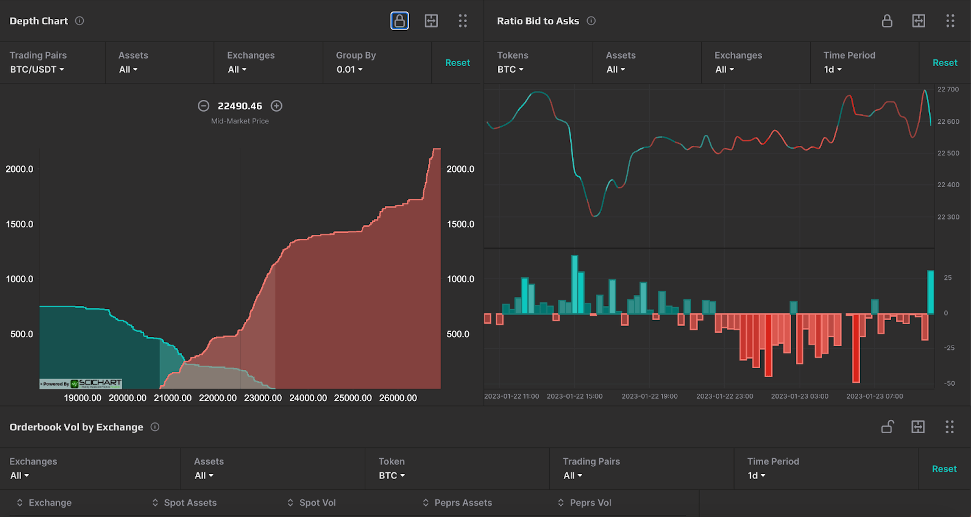
Recently, Dexilon released a robust tool for traders – Dexilon Terminal. It is designed to support traders by gathering data from leading centralized and decentralized exchanges, macroeconomic indicators, DeFi, and more. This comprehensive information helps traders make well-informed decisions through insightful charts. The following charts are now available:

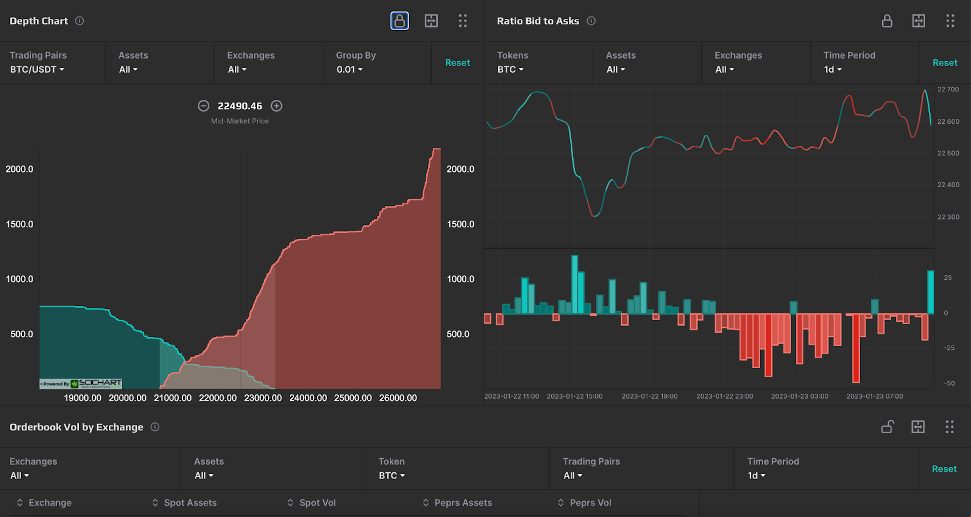
  • Depth Chart displays order book data from major CEXs, enabling traders to identify potential barriers and determine the current trading channel.
  • Bid-to-Ask Ratio indicates potential price changes based on the balance of bids and asks.
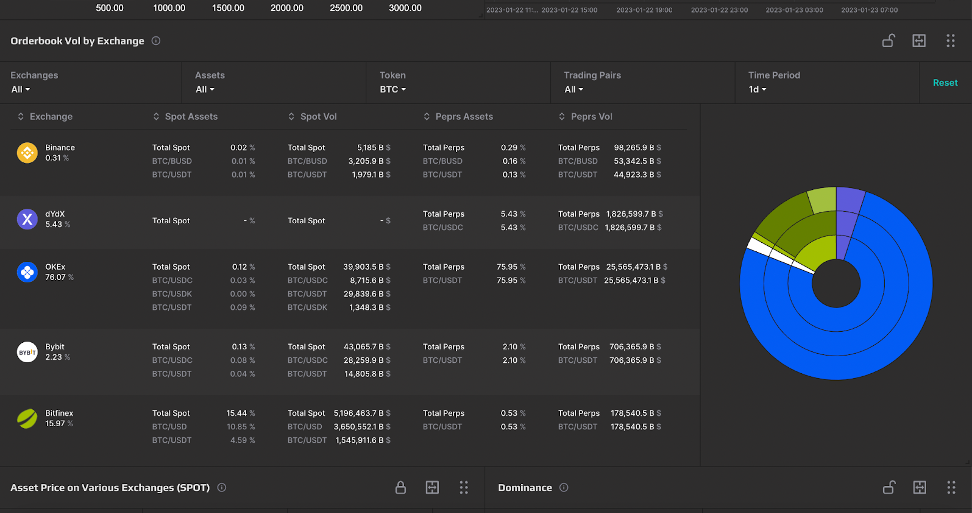
  • Order Book Volume by Exchange assesses liquidity across asset classes, such as derivatives or spot, in major exchanges.
  • Asset Price on Various Exchanges (SPOT, Futures Perpetual) offers a convenient tool for discovering arbitrage opportunities.
  • Dominance presents the token’s market cap percentage within the overall crypto market capitalization.
  • Orderbook Walls highlights the trading volumes happening at certain price levels, concentrating on the existing price walls. This tool assists traders in identifying the current trading channel.
  • Volume-Weighted Average Price (Spot, Futures Perpetual) evaluates the liquidity of assets across multiple exchanges and informs traders about slippage and potential price shifts.
  • Trading Vol Distribution (Spot, Futures Perpetual) illustrates the volume of buying and selling activity for an asset at a given price. This chart helps determine critical price levels.
  • Orderbook vol by time (Spot, Futures Perpetual) shows the historical evolution of liquidity, providing valuable insights for trend analysis and informed trading decisions.
  • Top Performer displays a list of tokens ranked by the percentage of their price increase
  • Top Loser provides a list of tokens sorted by the percentage of their price decrease.
  • DEX vs CEX Marketshare (Spot, Futures Perpetual) displays DEX and CEX market shares, based on liquidity data.
  • Listings&Delistings offers details about trading pairs, the platform used, and the timing of the listing or delisting, equipping traders with valuable insights for potential opportunities.


Dexilon Terminal has already been updated to make it more convenient and faster. More exciting things are coming up, since Dexilon is currently working on a chart with metrics about exchanges’ credibility to be able to present users with easily digestible information about the scam score for exchanges. Dexilon Terminal is currently free of charge for everyone, but eventually it will be free for Dexilon users only.

3Commas

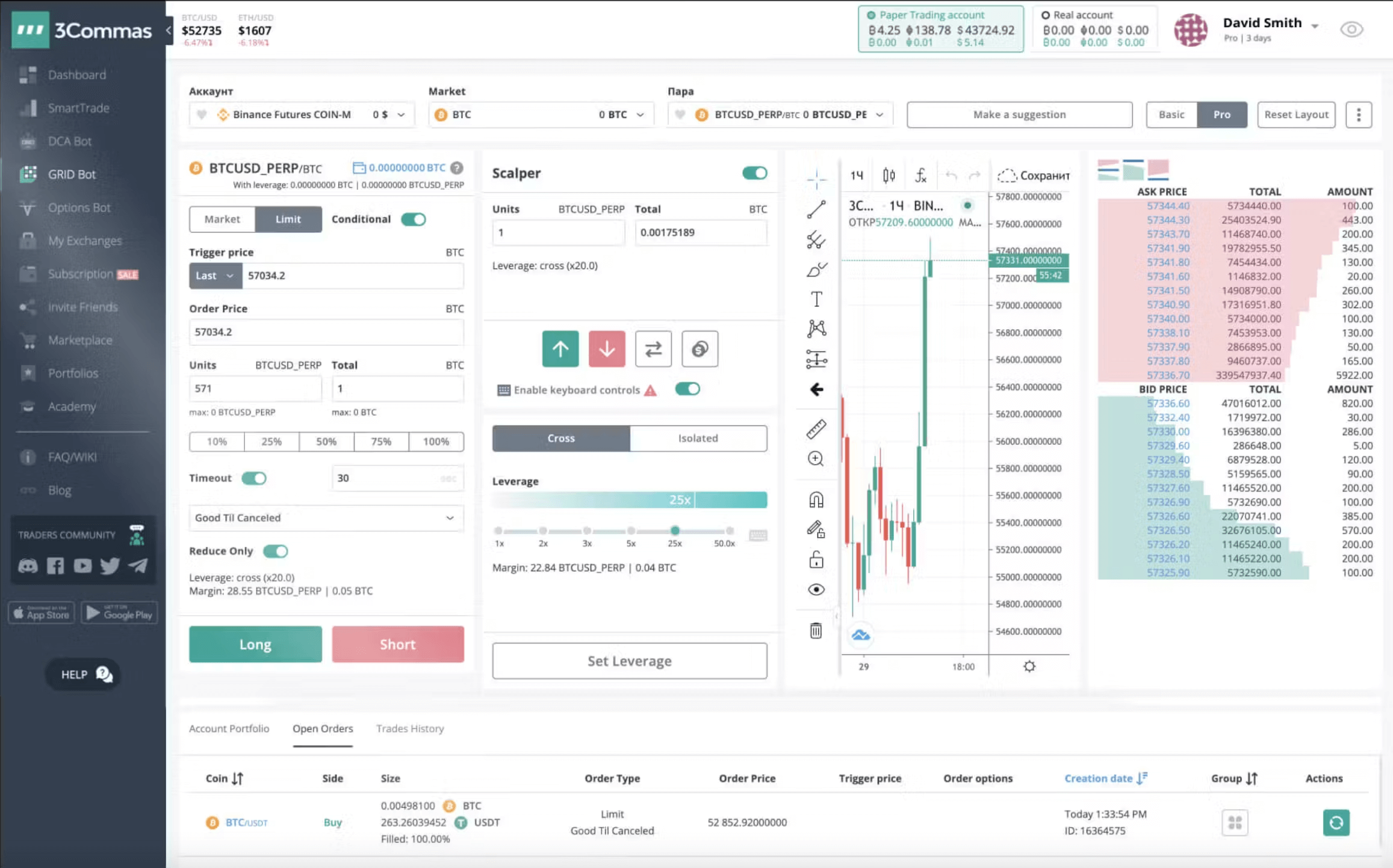
3Commas is among the top-tier and cutting-edge trading terminals in the crypto space. As a cloud-based platform, it is accessible as a crypto desktop terminal or mobile apps. Available exclusively for premium plans, users gain access to 23 supported exchanges, a multi-tiered referral program, a public API, a unified portfolio for all crypto accounts, complimentary mobile apps, and paper trading. By minimizing technical hurdles for platforms and partners, 3Commas Cloud allows you to concentrate on user acquisition and enabling local fiat access, maximizing your revenue potential in the cryptocurrency trading space. 

The terminal offers a free trial and three different plans Starter, Advanced and Pro. The prices range from $29 to $99 with the chance to get a discount of up to $22 and $74 respectively, if you pay annually.

Altrady

Based in the Netherlands, Altrady is a crypto trading terminal that offers access to several exchanges through a single platform. Altrady streamlines your trading experience by consolidating control over multiple exchanges in a single platform. Offering unique visual feedback on positions and trade history, it delivers valuable insights into your profit progress. The upgraded mobile app provides a great trading experience across all exchanges, eliminating the need for multiple apps.

The integrated alert system monitors positions and sends instant notifications through the terminal or mobile app, enabling efficient trade management and granting you time away from the screen. Smart trading functions let you set up comprehensive entry and exit strategies, allowing the system to manage positions automatically. With easy-to-use signal and grid bots, Altrady helps increase trading productivity while minimizing unnecessary losses. 

Altrady offers a limited free version for those who want to try the system with no risk. There are also three packages with more advanced offering: Basic, Essential and Premium with €17.47/mo, €31.47/mo and €55.97/mo respectively.

Coinigy

Coinigy, a multi-exchange trading software originating from Milwaukee, has been catering to the cryptocurrency market since 2014. With Coinigy, you gain access to over 45 exchanges and benefit from Coinigy’s extensive connectivity throughout the crypto realm. Enjoy real-time pricing data, full-featured spot trading, Arbitrage Matrix, and comprehensive portfolio management tools. Coinigy provides SMS and email alerts for prices and trades, keeping you informed and ahead of the competition. As an all-in-one solution for monitoring exchanges and wallets, Coinigy serves as an exceptional anti-theft resource for cryptocurrencies. 

Experience no additional exchange fees and select from subscription options after the trial period. The pricing model is pretty simple: PRO TRADER package costs $18.66 per month and API DEV PRO – $99.99 per month. Coinigy also offers a 7-day free trial. 

Atani

Next up is Atani, a versatile trading application that serves as your all-in-one access point to over 22 different cryptocurrency exchanges. Atani lets you execute professional-level trades with advanced order types such as Stop Loss, Take Profit, and OCO. It’s a non-custodial platform, meaning your funds and API keys stay secure, as Atani doesn’t have access to them. Operating by connecting to crypto exchanges via API keys, Atani gives you the freedom to trade like a pro without any hidden costs. Enjoy its powerful features without worrying about monthly subscriptions or hidden charges – Atani is completely free to use.

HyperTrader

HyperTrader boasts a plethora of remarkable features, making it the perfect tool for day traders, swing traders, and scalpers alike. Its enhanced user experience and improved efficiency allow for swift actions, potentially resulting in significantly increased profits. The platform’s unique split-chart functionality enables users to monitor multiple assets across different exchanges simultaneously. With the ability to display up to four charts at once and choose from fifteen distinct layouts, users can optimize their screen space for seamless trading. The multi-chart trading feature synchronizes symbols, intervals, crosshairs, time, and drawings, ensuring that users can customize their views to suit any requirement.


The evolving landscape of cryptocurrency trading platforms offers a myriad of tools and services to aid traders. Dexilon, with its recently launched Dexilon Terminal, provides comprehensive market data and enhances trading efficiency. 3Commas, with its cloud-based solution, facilitates multi-exchange trading and portfolio management. Altrady stands out with its unique visual feedback system, advanced alert system, and smart trading functions, while Coinigy offers extensive connectivity, real-time data, and robust portfolio management tools. Atani and HyperTrader, each with their own unique features, provide further alternatives for those seeking to diversify their trading toolkit. As the crypto market continues to grow, these platforms are pushing boundaries to provide a more efficient, secure, and profitable trading experience. HyperTrader is available for free.

Best crypto terminals – the advantages of using the new technology

The crypto trading terminal offers a range of advantages that cater to the needs of modern traders:

  • Personalized trading experience: The crypto terminal is highly customizable, allowing traders to tailor it to their specific strategies. This flexibility ensures a seamless trading experience aligned with each individual’s preferences and objectives.
  • Comprehensive data consolidation: By aggregating data from various crypto exchanges, the trading terminal provides users with a holistic view of market trends and opportunities. This comprehensive data access enables traders to make well-informed decisions based on extensive market information.
  • Centralized trading toolkit: The crypto trading terminal brings together all essential trading tools and resources in one location, streamlining the trading process. This centralized approach not only saves time but also increases efficiency, allowing traders to focus on executing successful trades and maximizing their returns.

Crypto terminals provide traders with a customizable, data-driven, and centralized solution that enhances their trading experience. By offering a personalized environment, comprehensive market information, and an integrated suite of tools, the best bitcoin terminal empowers traders to make informed decisions and streamline their workflow, ultimately leading to improved trading outcomes and maximized returns.

Best trading terminal for crypto and how they work 

Crypto trading terminals operate by delivering a suite of features designed to optimize the trading experience for users:

  • Connection to multiple crypto exchanges: The trading terminal crypto allows users to connect to a variety of crypto exchanges, providing them with an extensive range of trading options and opportunities. This connectivity ensures a seamless and diverse trading experience across multiple platforms.
  • Advanced order types: The terminal supports the execution of sophisticated order types, such as Trailing Stop, Take Profit, and more. These advanced order options grant traders greater control over their trading activities and help them manage risks effectively.
  • Advanced data visualization: The terminal presents data in sophisticated graphs and charts, enabling users to better understand market trends and dynamics. These visualizations simplify complex data, making it more accessible and actionable for traders of all skill levels.
  • Comprehensive analytical tools: The trading terminal offers an array of tools for in-depth market analysis, empowering users to make informed decisions based on their insights. These tools provide traders with a solid foundation for crafting successful trading strategies.
  • Rapid order placement and cancellation: The terminal’s speed and efficiency allow users to place and cancel orders with minimal latency. This lightning-fast response time ensures that traders can react quickly to market changes, seizing opportunities and minimizing losses.

By offering these powerful features, the crypto trading terminal delivers an advanced, efficient, and user-friendly trading environment that caters to the diverse needs of modern traders.

In conclusion, professional crypto trading terminals such as Dexilon, Atani, HyperTrader, 3Commas, Altrady, and Coinigy are revolutionizing the way we approach cryptocurrency trading. These platforms blend innovation with efficiency, offering diverse functionalities from advanced order types to seamless multi-exchange connectivity, customizable alerts, and robust portfolio management tools. 

Whether you are a seasoned trader or a novice venturing into the crypto world, these trading terminals provide a variety of features designed to streamline your trading journey. They deliver on their promise of transforming the trading experience, making it more insightful, secure, and profitable. Choose the one that suits your strategy and requirements the best and embark on your enhanced trading journey today. Remember, most of these platforms offer free trials or even fully free services, allowing you to take them for a spin before committing.

FAQ

What is Crypto Trading Terminal?

Crypto Trading Terminal is a specialized software platform that enables users to effectively monitor, analyze, and trade cryptocurrencies. By providing a comprehensive suite of tools, it streamlines the trading process and allows users to make more informed decisions based on real-time market data and advanced analytics.


For instance, imagine a day trader who wants to capitalize on short-term price fluctuations in Bitcoin. Using a Crypto Trading Terminal like Dexilon, they can access real-time price charts, spot emerging trends, and apply technical analysis to identify optimal entry and exit points. This helps them execute trades with precision and minimize losses.

How does Crypto Terminal work?

A Crypto Trading Terminal works by connecting to various cryptocurrency exchanges and aggregating market data, such as price and trading volume, into a single platform. In simple words, it’s like a control center that gathers all the essential information you need to trade cryptocurrencies.


When you use a Crypto Trading Terminal, you can access real-time price charts and other tools that help you understand how the market is behaving. You can also analyze historical data, apply technical indicators to spot trends, and set price alerts to stay informed about market movements.


Additionally, Crypto Trading Terminals often allow you to manage your trades directly from the platform. This means you can buy, sell, or even automate your trading strategies without having to visit multiple exchanges. You simply connect your exchange accounts to the token terminal, and it takes care of executing the trades on your behalf.


In short, Crypto Trading Terminals simplify the trading process by providing an all-in-one platform where you can access market data, analyze trends, and manage your trades with ease.

What is the best crypto trading terminal?

The Dexilon Terminal stands out as the best crypto trading terminal by offering a great combination of benefits:

  • Comprehensive data sources: Dexilon Terminal goes beyond simply consolidating data from various crypto exchanges. It also includes valuable insights from macroeconomic indicators, DeFi platforms, and both centralized and decentralized exchanges, providing traders with a richer and more diversified data pool for informed decision-making.
  • Cutting-edge analytical tools: The Dexilon Terminal offers an array of advanced charting and visualization tools designed to help traders better understand complex market dynamics. These innovative tools, combined with a user-friendly interface, enable users to perform in-depth market analysis efficiently and effectively.
  • Cross-platform compatibility: The Dexilon Terminal is compatible with popular crypto wallets like MetaMask and Binance Wallet, ensuring a hassle-free experience for its users.
  • Community-driven approach: Dexilon Terminal places a strong emphasis on community governance, empowering users to contribute to the platform’s ongoing development and improvement. This democratic approach fosters a sense of collective ownership and encourages innovation, driving the platform’s continued growth and success.
  • Security and transparency: The Dexilon Terminal upholds the highest standards of security and transparency, thanks to its decentralized architecture and open-source features. Users can trust the platform to prioritize their safety and privacy, as well as to provide a fair and transparent trading environment.

Which crypto trading terminal is free to use?

Several crypto trading terminals offer free use, each providing unique benefits:


  • Dexilon: Dexilon boasts several impressive features. As one of the best crypto terminals provides a secure, transparent, and community-governed trading platform powered by its native blockchain. Dexilon also excels at handling a high volume of transactions per second (TPS) without the risk of congestion.
  • Atani: Atani stands out for its truly free-to-use trading platform that connects to over 22 different crypto exchanges. It empowers traders with advanced order types like Stop Loss, Take Profit, and OCO, operating as a non-custodial platform for enhanced security.
  • HyperTrader: HyperTrader provides a free version with a range of features perfect for day traders, swing traders, and scalpers alike. It enhances the user experience and improves efficiency, enabling users to monitor multiple assets across different exchanges simultaneously.

Meanwhile, other platforms like 3Commas, Altrady, and Coinigy offer free trial periods:


  • 3Commas: Known for its cloud-based platform, 3Commas provides users with a trial period to experience its multiple exchange trading and portfolio management capabilities.
  • Altrady: Offering a unique visual feedback system, smart trading functions, and an advanced alert system, Altrady also allows users a trial period to experience its functionalities.
  • Coinigy: Coinigy offers a trial period to users to experience its extensive connectivity, real-time pricing data, and robust portfolio management tools.

While free offerings or trials don’t encompass the full extent of features, they allow you to experience each platform’s unique benefits and choose the best cryptocurrency trading terminal that aligns with your trading strategy and needs.

Before we dive into answering the question “What is the best decentralized exchange?”, let’s take a quick look at what a crypto exchange is and how it works. Just scroll down to the next section, if you’re already well-versed in that topic.

A cryptocurrency exchange is a platform where you can buy and/or sell crypto assets, like BTC or DOT. You might have had some experience with regular trading platforms, and crypto exchanges function quite similarly to them. Some exchanges offer advanced trading features like derivatives trading. For example, Dexilon provides its users with the ability to trade crypto options, crypto futures, and also some exotic derivatives.

Here’s a list of the TOP decentralized exchanges: 

  1. Dexilon – Best DEX for Crypto Derivatives
  2. Bisq – Best DEX for Smaller Trades
  3. dYdX – Best Exchange for Margin Trading
  4. PancakeSwap – Best DEX for New Crypto Assets
  5. Uniswap – Largest Decentralized  Exchange
  6. Kine Protocol – Best Exchange for Low Prices 
  7. Curve Finance – Best DEX for Stablecoins 
  8. DODO – Best Proactive Market (PMM) Maker Exchange
  9. Balancer – Best Flexible DEX
  10. Apex Protocol – Best New DeFi Platform

If you wonder what are the types of crypto exchanges, there are roughly two of them – centralized and decentralized exchanges, and we’re going to focus on the second one in this article. But let us describe both of them briefly to compare.

Best decentralized Bitcoin exchanges – is it better to choose a DEX or a CEX?

This part might not be helpful for those who have already decided on either of the two types of crypto exchanges, but if you still try to decide if you should choose the best decentralized bitcoin exchange or the best centralized one, here are the main distinctions between them.

Centralized exchanges (CEXs) are controlled by an organization. One of the biggest advantages of centralized exchanges is that they allow users to trade their fiat currency like EUR or USD into crypto assets. 

As a user of the CEX, you will have to go through the KYC (Know Your Customer) process. This means that before you get to exchange your crypto, you will have to get verified by the platform which involves providing them with your personal information, like your address and ID details. This KYC policy is aimed at tackling cyberattacks and securing everyone’s assets. However, the money being held by a centralized entity inevitably puts it at risk of being stolen by hackers.

These days, the majority of crypto trading transactions are being performed on centralized exchanges. Primarily because this type of exchange appeared first. However, it has some disadvantages, including security issues, which became the reason why decentralized exchanges appeared on the market over time.

Decentralized exchanges (DEX) are much more autonomous than centralized exchanges. They run on smart contracts, and computer protocols that execute, control, and document transactions under specific circumstances. DEXs allow anonymity and flexibility for users since there are usually no KYC requirements.

When you hold your crypto on a centralized exchange, it takes control of your funds. With the DEX though, you stay in control of your assets and, thus, this is considered a safer way to trade crypto. With most DeFi exchanges, you trade directly from the wallet connected to the platform. One of the biggest downsides of decentralized exchanges is that you won’t be able to exchange your fiat currency for crypto, so you need to hold some crypto in your crypto wallet, like MetaMask before you try to exchange it for the other currency on the platform.

Let’s proceed to learn about the biggest benefits of the best decentralized exchanges.

Best decentralized crypto exchanges – what are their advantages?

Best decentralized cryptocurrency exchanges have several benefits that make them more and more attractive to users. Take a look at the list below.

  • The range of assets available. One of the biggest perks of DEXs is that you usually get access to a tremendous number of coins. It’s much easier to add new coins to a decentralized exchange, as centralized ones require going through a complicated verification process. So new coins usually emerge much faster on decentralized exchanges and before this coin grows in price, you can be one of the lucky dogs, who gets it for a very reasonable price.
  • Anonymity and better privacy. DEXs usually don’t follow a KYC protocol, so you do not need to submit your personal data to a decentralized exchange, so your data won’t be stolen or violated. 
  • Much lower fees. The exchange does not hold your assets as an intermediary, which means that there’s less work involved on their side, so the fees are usually lower.

Decentralized exchanges were created as a response to the restrictions of the centralized ones and made them available to a wider audience of crypto enthusiasts and, despite their own limitations, they are gaining more popularity. Since there’s a huge number of decentralized exchanges these days, you need to know the most important criteria to choose the best dex cryptocurrency exchange available on the market. Keep reading to learn more.

Best DEX exchanges – the criteria for choosing a perfect platform you won’t regret joining

When choosing the best dex crypto exchanges, you need to be aware of what you should be looking at. To be able to separate the wheat from the chaff, there are roughly 7 factors you need to check to make sure the platform is reliable and legit. You are free to prioritize them depending on your needs and preferences.

  • Fees and their transparency. Fees are never a pleasant thing, but they are deeply frustrating if they eat up a lump sum of your rewards. So make sure you study the fees of the exchange you’re choosing before you invest any money. If the platform doesn’t openly describe its fees, it’s automatically a red flag – you came to DeFi for transparency, didn’t you?
  • Security. Even though your money is not held by the exchange, it’s essential to choose an exchange that takes safety seriously. Cybercriminals are evolving along with security measures, so choose an exchange that uses the latest and most reliable achievements of security software.
  • Supported coins. If you’re into trying new assets, and it’s important for you to be able to trade a wide range of cryptocurrencies, you should look for a platform that supports a wide range of coins. However, if you’re one of those who prefer to let others test the waters, and usually stick to the trusted assets, choose any of the five exchanges below, they have more than enough.
  • Payment methods. It’s important when you can buy crypto using a convenient way of payment. Especially, if you’re new to crypto, it’s important to have at least a small area where you know what to do and how to do it. So look for an exchange that supports the most suitable payment method personally for you.
  • Customer service. Seems like one of the least important factors on the list, but, believe me, you don’t want to have an indifferent person on the line or, which is even worse, didn’t get any response when you have some issues with your transactions. 
  • Customer reviews. I doubted if I have to write it because that’s what you’re doing right now – gathering information and trying to figure out what is the best decentralized exchange for crypto. But you can go one step further. For example, type in Google “best decentralized exchange Reddit” to read the real discussions of the crypto enthusiast who tried different exchanges and chose the one.

And now the moment came – we’ll break down 5 crypto DEXs and let you define your best decentralized exchange for crypto. They all have their benefits and downsides, so as I’ve written earlier, we can’t decide which one suits your needs best – you’ll need to do it on your own.

Best decentralized exchange to buy crypto

We’ve studied the market and prepared a list of 10 exchanges that are worth trying. Some crypto traders prefer to trade on several platforms, while others choose their best dex exchange to buy crypto and stick with it. Take a look at the best bitcoin exchanges we’ve studied and choose according to your needs.

Platform Fees Tokens Min trade Overall impression
Dexilon 0 gas cost, 0.1% rebate for maker and 0.05% for taker that can be reduced to 0.015% over 10 n/a The best new crypto derivatives exchange on the market with no gas costs
Bisq from 0.1% to 0.70% transaction fee over 120 n/a An exchange with a wide range of payment methods and coins
PancakeSwap 0.25% transaction fee over 50 n/a A great exchange for new cryptocurrencies
dYdX 0% for trading volumes of less than $100,000/mo over 35 n/a A perfect crypto exchange for margin trading
UniSwap 0.3% fee on transactions + gas fee 18 n/a Great exchange with unlimited liquidity and a lot of bonuses
Kine Protocol maker fee is 0.02% and the taker fee is 0.04%. Fees depend on trading volumes over 400 n/a The largest DEX on the market
Curve Finance fees range from 0.04% to 0.4%, depending on the trading pair and liquidity over 8 n/a Offers multiple liquidity pools
DODO 0.3% flat fee on trades 11 n/a PMM algorithm wth efficient on-chain liquidity for Web3 assets
Balancer a flat fee of 0.3% for both maker and taker transactions. Withdrawal fee is 0.05% 52 n/a Flexible exchange with numerous options for passive income
Apex Protocol a flat fee of 0.2% for both maker and taker transactions 5 n/a A wide range of DeFi features, but a limited number of supported coins
  1. Dexilon

    With Dexilon, you’ll be in control of your assets, since the platform will not store them – they will be kept in a smart contract linked to your self custody crypto wallet, like MetaMask. Dexilon offers very competitive fees, primarily because there are no gas costs. Economic model. Data providers and oracle node validators will be compensated from a portion of a taker fee. The taker fee ranges from 1,5 to 5 bps, whereas there is a rebate of 1 bps. 20% of this difference is an oracle reward. If we take a median of 3 bps, the oracle will receive 0,4 bps (3-1)*20% of a taker fee. These rewards are accumulated on the Dexilon chain and are redistributed every 8 hours. 

    Dexilon oracle requires a set of nodes that will validate the data collected from data providers. For this, this chain will get 30% of the rewards. The rest will go to data providers.

    Another cool thing about this exchange is that they also provide the users with the chance to learn about how the exchange works without investing a single Bitcoin – a Testnet they launched recently, despite not being packed with multiple features, teaches you the basics. What’s more, Dexilon is also considered one of the best crypto derivatives exchanges – read a full review to learn about it. Overall, you’ll be able to trade crypto on a safe platform with no KYC requirements and roof-breaking fees.

    Pros

    • Self custody with personal cryptocurrency wallets
    • A wide range of liquid crypto derivatives in addition, including

    Cons

    • Relatively new and less-known
    • Testnet for a risk-free crypto futures experience
    • Liquidity incentives and gasless trading
  2. Bisq

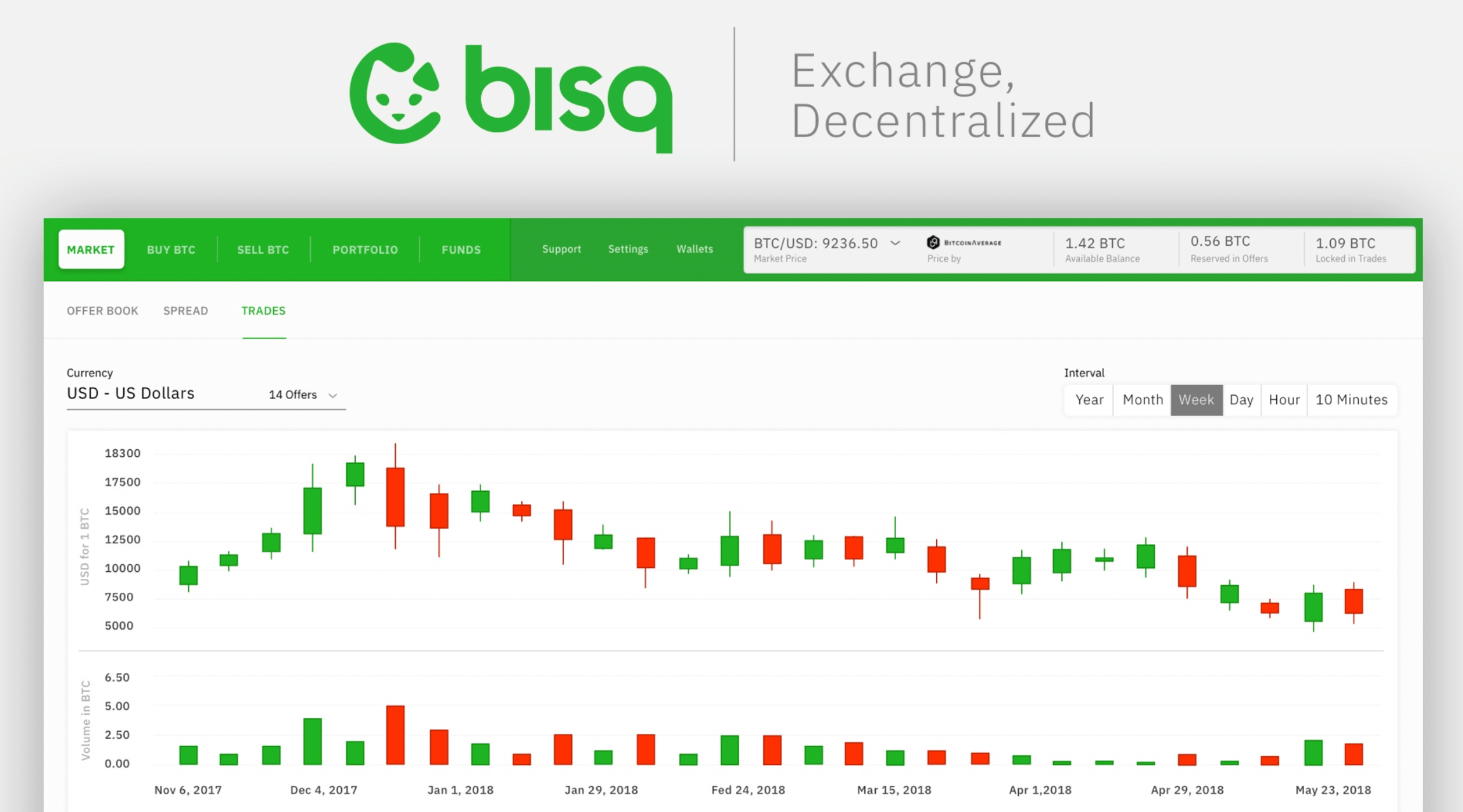
    Bisq is a decentralized exchange available globally. Similarly to Dexilon, it has no KYC and offers a great degree of privacy. It’s been on the market for more than 8 years and offers a wide range of crypto assets (currently more than 120). The number of payment methods is also great, starting from traditional bank wire transfers to cash deposits and even more. The exchange is targeted at making smaller trades which can deter some users, but it’s a great option for those who prefer trading anonymously on a DeFi platform with no KYC and a good choice of tokens.

    Pros

    • Wide range of coins
    • No KYC  needed 
    • Instant approval for withdrawals

    Cons

    • Trading fees are above average
    • The app is pretty basic
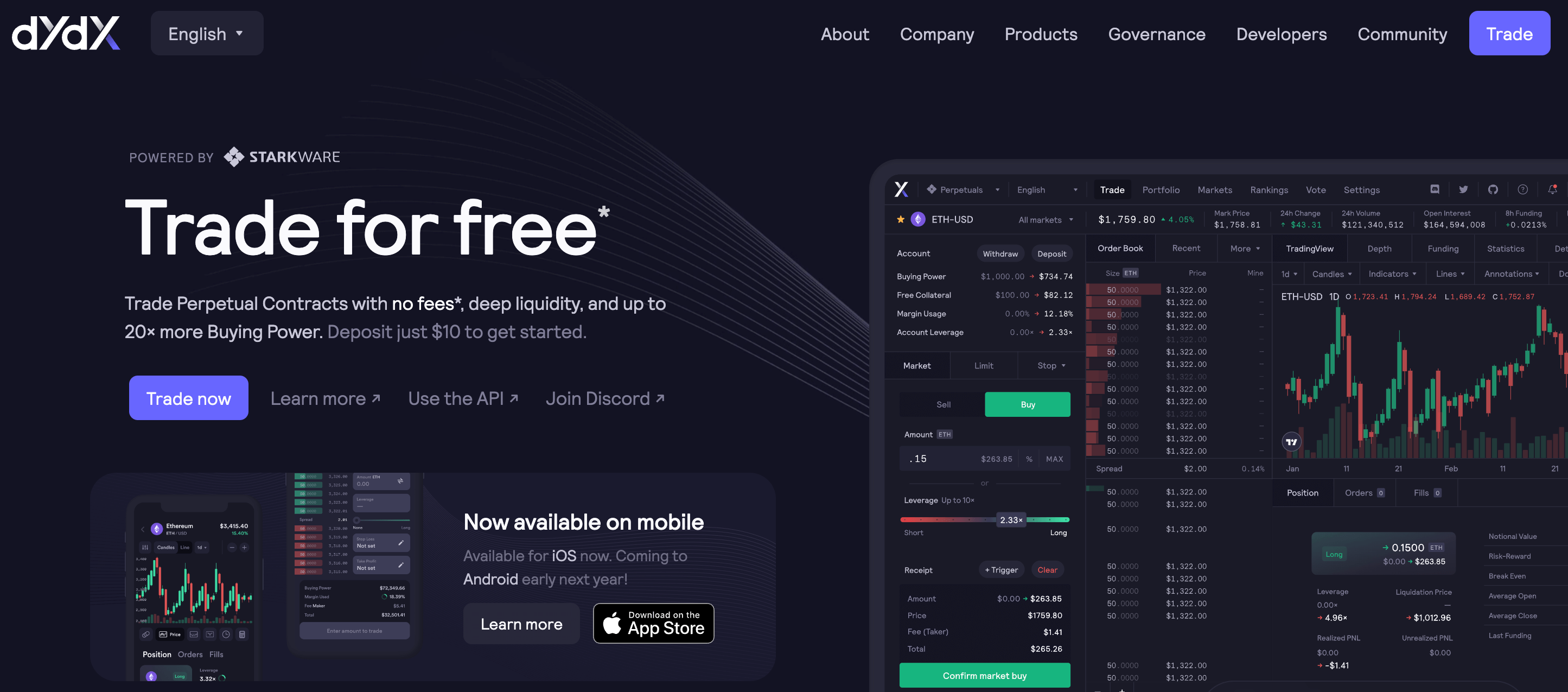
  3. dYdX

    dYdX has a reputation as one of the groundbreaking crypto exchanges for margin trading and crypto derivatives. Due to the great funding ($87 million) from the very foundation of the exchange in 2017, the dYdX team managed to work on great financial technologies for crypto trading. For example, it’s a first-of-its-kind crypto derivatives exchange that focuses exclusively on crowdsourced liquidity. This means that when you deposit collateral in order to open a leveraged trading position, you’re borrowing funds from a liquidity pool that consists fully of the crypto deposited by traders.


    Pros

    • No gas costs are charged
    • Ease of use – well-thought UX

    Cons

    • Limited number of trading pairs
    • Deposits and withdrawals are only in crypto
  4. PancakeSwap

    PancakeSwap seems to be the most popular exchange for finding new cryptocurrencies due to the platform’s simple listing process. This might not be “your” exchange if you prefer to invest in well-known tokens only. However, buying no-name cryptocurrencies can make you rich one day, you never know. It was built on the Binance Smart Chain, however, it has recently integrated with the Ethereum blockchain giving its users access to a bigger number of coins and more liquidity


    Pros

    • Generous rewards including NFTs, lotteries etc.
    • High daily trading volumes resulting in low slippage 


    Cons

    • No customer support
    • No mobile app
  5. Uniswap

    UniSwap is definitely one of the biggest DEXs that run on the Ethereum blockchain. Despite being large, UniSwap offers quite low fees making it attractive to more users. Crypto enthusiasts who also stake tokens in a liquidity pool get the chance to earn additional interest. Holders of their UNI token can participate in the exchange’s governance and together make decisions on the platform’s growth plans


    Pros

    • Low flat-rate trading fees
    • Users retain custody of the coins


    Cons

    • Fake coins are a risk since it’s easy to add new coins to the platform
    • Higher-than-average fee
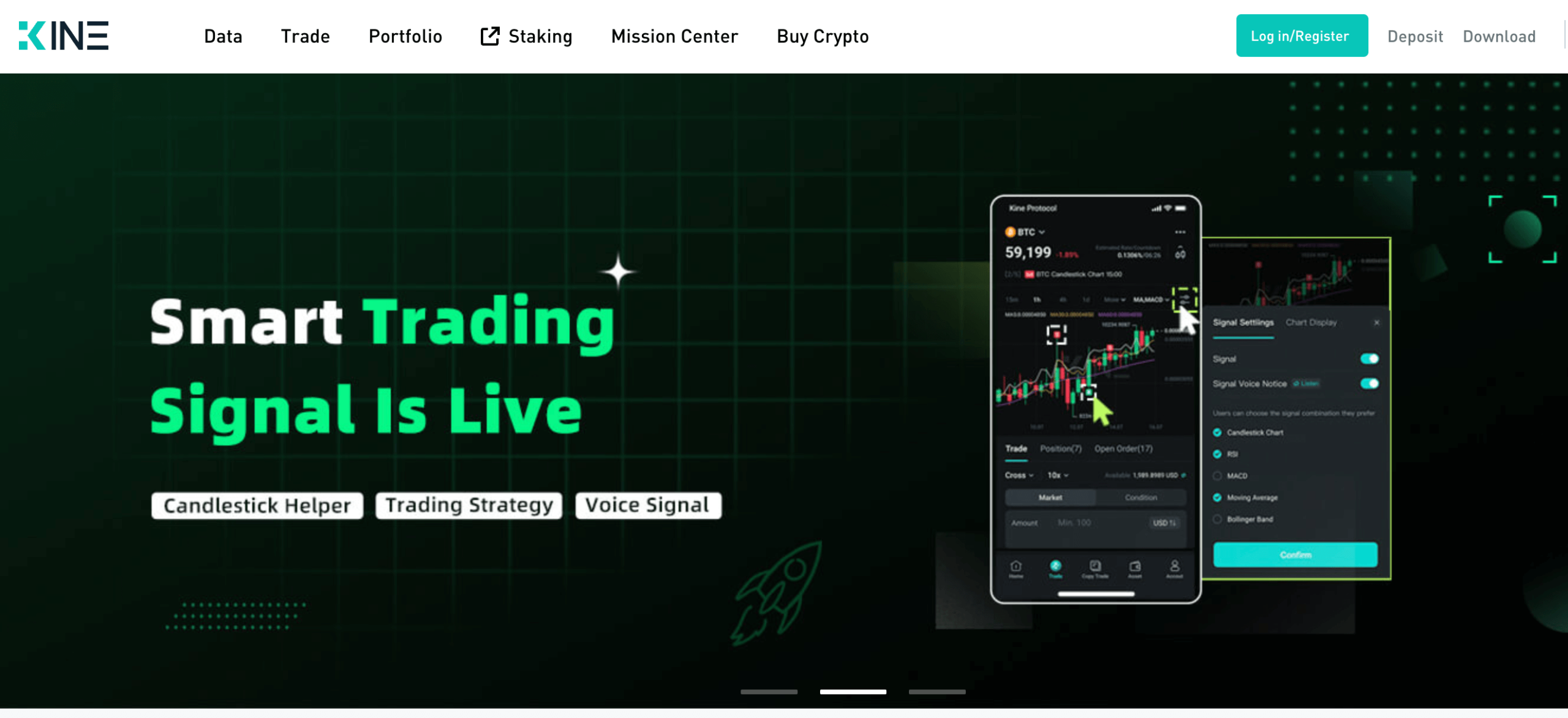
  6. Kine ProtocolKine Protocol is one of the best DeFi Bitcoin exchanges. It offers unlimited liquidity and has a trading volume of over $260M. The platform is designed to provide users with diverse benefits that can be earned by playing and learning. Kine Protocol’s unlimited liquidity ensures that users can easily buy and sell assets without the risk of slippage or price manipulation. With a range of features and tools for experienced and novice traders, Kine Protocol is a promising option for those looking to participate in DeFi.Pros
    • Unlimited liquidity
    • Good trading volumes


    Cons

    • KYC is required
    • A limited number of coins to buy
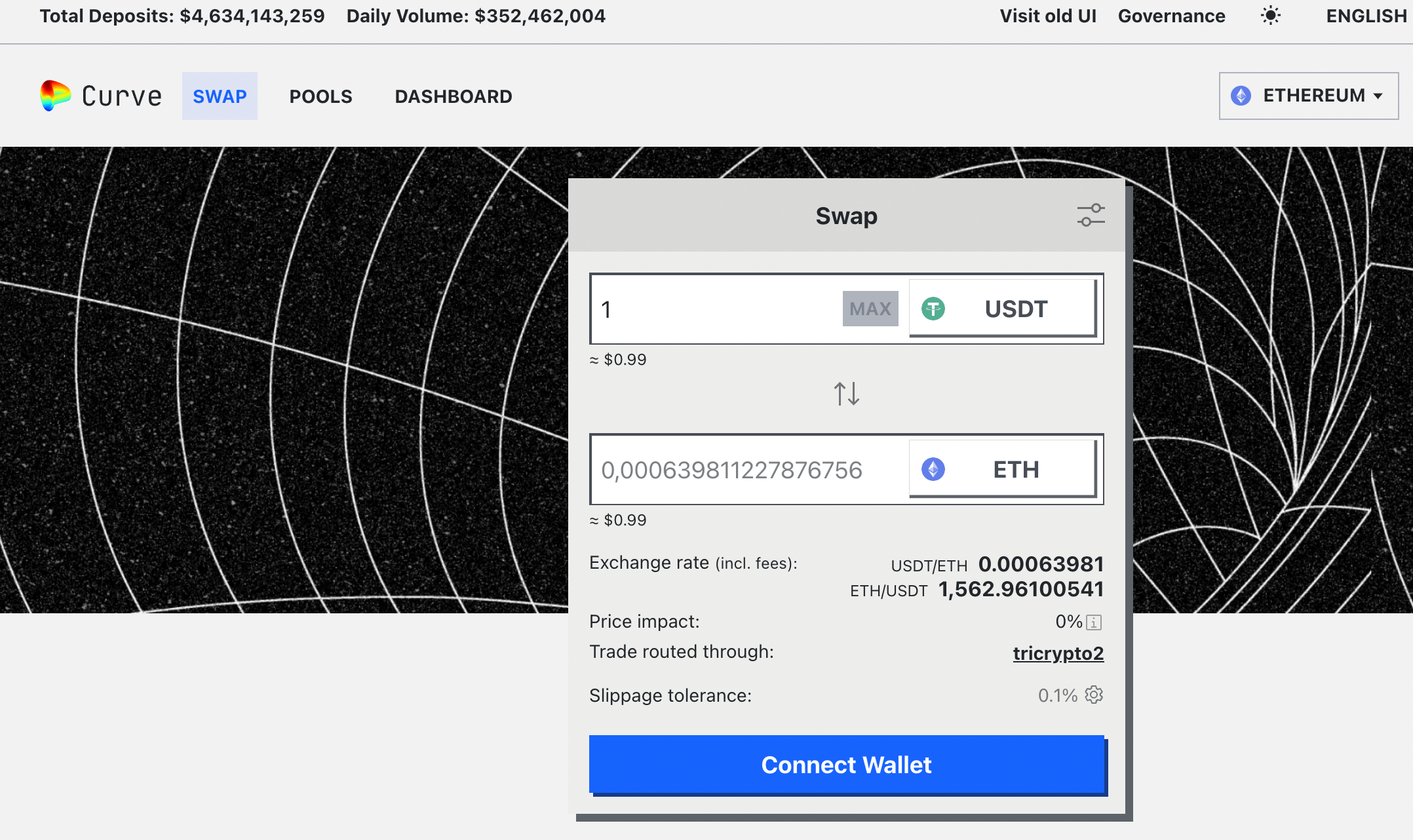
  7. Curve Finance

    Curve Finance is one of the best DeFi exchanges that offers numerous benefits for crypto traders. One of its greatest strengths is its non-custodial platform, which ensures users have full control over their tokens. Additionally, Curve offers multiple liquidity pools for users to choose from, allowing them to hold their tokens over a longer term instead of trading them. As a fully decentralized platform, Curve is governed by its community using CRV tokens, giving users a voice in decision-making.

    However, Curve is heavily dependent on the Ethereum blockchain and has a challenging interface for new users, and there is no mobile app available at this time. Despite these drawbacks, Curve is an excellent choice for those seeking easy stablecoin swaps, liquidity pool management, and low slippage.Pros

    • Non-custodial, you are in control of your money
    • Multiple liquidity pools


    Cons

    • Not very user-friendly
    • Heavily dependent on the Ethereum blockchain
  8. DODO

    DODO is one of the best decentralized trading platforms, which offers a unique Proactive Market Maker algorithm, enabling efficient on-chain liquidity for Web3 assets. It allows users to trade assets cross-chain, issue their own assets, and mint and fractionalizes NFTs. DODO also offers lucrative staking and LP mechanics, making it a popular choice among experienced DeFi users. DODO is a decentralized exchange, so KYC or account verification isn’t necessary, which could be a concern for users who prioritize security and regulatory compliance. Overall, DODO offers a comprehensive range of features for DeFi enthusiasts and project developers alike.

    Pros

    • Unique Proactive Market Maker algorithm with efficient on-chain liquidity for Web3 assets
    • Lucrative staking and LP mechanics


    Cons

    • Smaller user base compared to more established platforms
    • Being relatively new, there is some uncertainty around DODO’s long-term viability
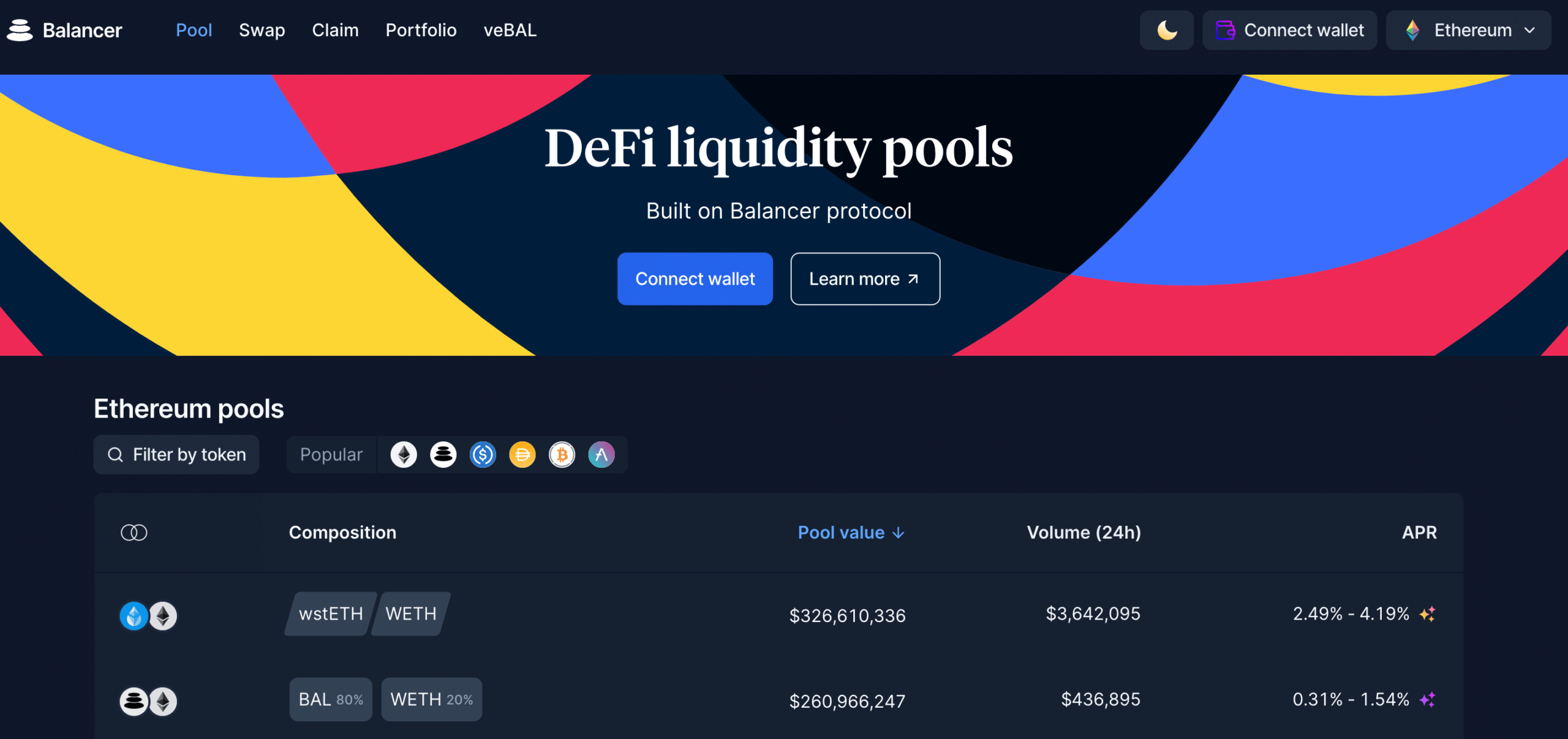
  9. Balancer

    Balancer is one of the best decentralized cryptocurrency exchanges that offers an automated market maker (AMM) system for liquidity provision. It allows users to swap cryptocurrencies and create or participate in customized pools with their own weights, fees, and trading rules. Balancer also offers a range of DeFi features, including staking, liquidity provision, and governance voting. One of the advantages of a Balancer is that it enables users to earn passive income through liquidity provision, with higher fees for pools with less liquidity. However, Balancer has also faced some security concerns and hack attempts, which have led to improvements in its security measures. Overall, Balancer is a flexible and innovative DEX that has gained popularity among DeFi users.Pros

    • Users can customize pools with their own rules and earn passive income
    • DeFi features like staking, liquidity provision, and governance voting


    Cons

    • Balancer has faced security concerns and hack attempts, leading to improved security measures
    • Customization options may be overwhelming for new users.
    • Liquidity on Balancer is lower than on more established DEXs
  10. Apex Protocol

    Apex Pro is a decentralized exchange (DEX) that operates on the Ethereum blockchain, allowing users to trade cryptocurrencies in a secure, transparent, and efficient manner. It boasts fast trade execution, low transaction fees, and a user-friendly interface that makes it easy for both experienced and novice users to navigate. Apex Pro also offers a wide range of DeFi features, such as staking, yield farming, and liquidity provision, allowing users to earn passive income on their holdings. However, as a relatively new DEX, Apex Pro may face challenges in attracting liquidity and building a robust user base compared to established platforms. Nonetheless, Apex Pro is one of the best decentralized crypto exchanges and a promising platform that offers a compelling value proposition for DeFi enthusiasts.Pros

    • Fast trade execution and low transaction fees
    •  A range of DeFi features, such as staking, yield farming, and liquidity provision


    Cons

    • Smaller range of trading pairs compared to more established DEXs
    • Limited security measures in place compared to more established DEXs

How do I trade in DEX? Appreciating the beauty of no-frill decentralized platforms

Why are people choosing decentralized exchanges these days? Mostly to be in control of their assets and make sure that guys like SBF won’t mess with their money. However, another big plus of DEXs is their anonymity – you will not have to sign up and go through any verifications which is a bliss compared to KYC circles of hell on the centralized platforms.

Here’s an example of simple start on a decentralized platform:

  • Connect your wallet (MetaMask or Binance) to the exchange
  • Deposit funds to start trading
  • Buy and sell derivatives
  • Track your position to ensure the most profitable deal

Since crypto derivatives trading is quite risky, a great way to get the hang of trading crypto derivatives on a DEX is to try the Testnet version to get a risk-free experience of the process and get ready for the first profitable deal.

Final thoughts on choosing the best crypto exchange

When choosing a crypto exchange, there are a few things to keep in mind. First and foremost, security is key. Make sure to choose an exchange the best crypto exchange USA that has a good reputation and is well-encrypted. Secondly, fees can vary widely from one exchange to another, so be sure to compare and find the best option for you. Finally, consider the geographical restrictions of the exchanges you’re considering; some only operate in certain countries or regions. With all of these factors in mind, you should be able to find the best crypto exchange for your needs.

FAQ

What is the best crypto exchange no KYC?

Some decentralized exchanges that operate without KYC are Dexilon, PancakeSwap, Uniswap, and SushiSwap. 


Decentralized exchanges rely on the transparency and security of blockchain technology to facilitate transactions without the need for a centralized authority to oversee them. This means that users can trade cryptocurrencies peer-to-peer without providing personal identification information.


 Overall, the best cryptocurrency exchange with no KYC requirements will depend on individual preferences and needs.

Which exchange is best for cryptocurrency?

DEX platforms are becoming popular due to their decentralized, transparent, and secure nature. DEX offers benefits like privacy, no KYC, and lower fees compared to centralized exchanges. 


Some popular DEX options are Dexilon, Uniswap, Sushiswap, PancakeSwap, and Curve Finance. 


Dexilon is an emerging DEX platform that offers decentralization, transparency, security, and low fees through smart contracts. Due to its flexibility and commitment to security and transparency, it’s already considered the best exchange for cryptocurrency by many traders.

What is the safest crypto exchange?

Delixon is already considered the safest crypto exchange by a lot of traders due to its robust security system that ensures the safety of users’ funds and personal information. Being committed to security, Dexilon completed the security audit conducted by Hacken, a cybersecurity company that helps businesses protect themselves from online threats.


Dexilon is a decentralized exchange, which means that there is no central authority controlling the platform. This reduces the risk of hacking attacks or fraud that can occur on centralized exchanges that store user funds in a centralized location. You are in charge of your funds, not Dexilon.

Dexilon uses smart contracts to facilitate trades, eliminating the need for intermediaries and reducing the risk of human error or manipulation.

All transactions on Dexilon are transparent and publicly visible on the blockchain, providing an added layer of security and ensuring no room for fraudulent activities.

What is the lowest fee crypto exchange?

Dexilon is an excellent option for traders looking for lower fees. As a decentralized exchange, Dexilon uses smart contracts to facilitate trades, which eliminates the need for centralized authority and reduces overhead costs. This allows Dexilon to charge lower fees compared to centralized exchanges. Dexilon is one of the lowest fee crypto exchanges because of 0 gas cost and great rebates for both maker and taker fees.

Introduction

Dexilon is dedicated to delivering an exceptional trading experience by offering cutting-edge decentralized trade execution software, unparalleled security, and decentralized standards. We also aim to provide sustainable incentives for our stakeholders.

Our exchange is built on the foundation of two essential user groups: market-makers/LPs and traders who need liquidity.

For market-makers, we offer:

  • Rebates, with every maker order, rewarded 1 basis point
  • Zero gas cost, covered by the taker fee
  • Lightning-fast execution (less than 100 ms), providing a predictable trading environment

For traders, we provide:

  • Low fees, with taker fees starting at 5 basis points and as low as 1.5 basis points
  • No hidden costs, such as gas fees, included in the taker fee
  • A powerful trading terminal for informed decision-making
  • A referral and Robinhood program
  • Exciting trading competitions and much more

Our fundamental user proposition is situated around following pillars:

  • Ultra fast execution. Having a custom built Dexilon Chain allows us to guarantee a very high TPS and blocktime, without the risk of congestion
  • Limit order rebates – every limit order filled will be compensated 0.01% for providing liquidity
  • Ulta low and transparent fees for Taker Order. Suits very well for retail and professional takers. We are 30% cheaper than major CEXs and up to 100% cheaper than major DEX competitors
  • Being a decentralized protocol, and not taking direct revenue from trading fees, we are able to pass these cash flows to the community in a very substantial manner. 40% of Fees collected is aimed to be paid out for the Referral Program and Robinhood Pool
  • Truly Deflationary Token model. Our system of Fees redistribution and settlement of payments in DXLN is designed to greatly push up a token price. Traders, referrals, ambassadors and hodlers, will be able to directly profit from this design

We are planning to promote 5 fundamental pillars outlined above by constructing an effective and transparent referral and ambassador system.

The Dexilon Referral Program

The Dexilon Referral Program is designed to reward users who bring new traders to the platform. Users can receive up to 40% of the commission collected from their referrals, paid back to them every 30-day epoch.

This is one of the most generous referral campaigns on the market, made possible by our well-designed fee structure.

Another great incentive program for small traders is the Robinhood Pool. 10% of all taker fees collected will be distributed to the smallest group of traders, based on trading volume. If you trade below 100k volume per month, you will receive extra cashback for your taker volume.

The referral program and the Robinhood pool work together seamlessly, as groups of traders can join the platform and receive a portion of each other’s costs, as well as cashbacks from the Robinhood pool, filled by fees from all user groups. Essentially, larger traders incentivize smaller traders to join and provide liquidity, while the smaller traders receive financial benefits from the Robinhood pool.

Ambassador program

Carefully designed system is developed to create a loyal community and motivate the community to provide various services to promote and expand Dexilon reach. Some of the examples ambassador work:

  • Educational work – teaching communities how to trade at Dexilon and how not to pay ex
  • Content creation
  • 100+ referrals
  • Bug bounties
  • Regional coverage
  • Meet ups

Detailed ambassador program via the link.

Gamification

Typical problem we are looking to solve with the gamification, is that average user struggle to effectively navigate inside the DEX, when it first lands and then consequently drops.

We have partnered with an external SF based company to develop a Gamification solution, which is aimed to increase user stickiness and LTV.

Gamification at Dexilon is a set of visual quizzes and games inside the trading application, aimed to show, teach and support newcomers on how to efficiently use the platform and incur less mistakes and increase their experience.

Data terminal

We introduce a brand new concept of Data Terminal, which cannot be found anywhere else.

Data Terminal is an aggregated data sets which form trading indications from the biggest CeFi and DeFi venues. Users will be able to understand crypto market patterns by accessing real-time data on OrderBook Liquidity across all major exchanges, Sentiment Analysis on current affairs, correlations between stock indexes and various trading pairs, Analytics on relationship of Gas Prices vs Price of the Underlying Asset and much more.

Why is this important? Majority of retail customers, who trade derivatives, predominantly execute technical intra day trading strategies. They often lack sophisticated data about the very fragmented crypto market. Their strategies rely on intra day events, which they largely miss or have to pay substantial costs for the data and then execute the trade elsewhere. We are breaking this. At Dexilon users will have the most up to date and relevant information on liquidity, spreads, macro events in one place, while being able to directly execute trade at Dexilon Exchange. This is a tool which provides traders with the wide range of abilities like searching for walls of resistance or support through a depth chart which aggregates data throughout most popular exchanges. The terminal may provide many hints like how BTC price might act if there are 3 times more volume in asks than bids; provide an info real time about all listings/delistings so traders might profit from such events and much more.

The terminal opens a wide range of communication opportunities for Dexilon, as news related to exchanges are usually boring. With the terminal, Dexilon will have a much bigger variety of tools aimed to engage a community like rewards for proposing new graphs, finding new correlations which might impact crypto price and so on.

Target Promotional Channels:

  • Investors and partners community channels – organic
  • Influence marketing – paid
  • AMA sessions, Twitter Spaces
  • SEO – organic

Current Status:

  • SEO is fully operational. SEO results via the report
  • Ambassador program is ready for deployment
  • Referral program is developed and ready for deployment
  • Ready to invest funds into the influence marketing in the preparation of the mainnet

Сurrent Immediate action plan for Jan-Feb 2023:

  • Major informational/content release, i.e. Product documentation, Incentives and Token documents, Public trading API, Gitbook
  • Influence marketing campaigns with trading bloggers and youtube channels
  • Hiring additional 1 or 2 community managers (Currently 1 full time) to expand Discord and Reddit
  • Launch of Gamification product at the beginning of Feb 2023

There are few crypto folks left who haven’t heard anything about the FTX collapse in the past couple of days. The trust in crypto has shaken leading to multiple crypto assets dropping in price. And here they come again – crypto naysayers telling us again that crypto is just a big scam. Is that so? Let’s take a look at the facts and figure out if the notorious FTX story unfolding right now means that crypto is doomed (If you don’t have time to read the whole post, here’s the summary: NO).

What happened and why the crypto market looks like the city after the earthquake?

FTX, that used to be one of the biggest players in the crypto market, became insolvent in just a few days dragging the whole crypto market down with prices of tokens sinking drastically. But what happened? Here’s the recap.

Backstory

Binance used to be FTX’s early investor in 2019. Back then, CZ and SBF looked like bros that help and support each other. But then they suddenly broke up in 2021 when FTX bought out Binance’s remaining shares in the company. Binance received a big share of ~$2.1b in FTT (FTX’s token) and since then they became “somebody that I used to know” for each other and their CEOs never missed a chance to take shots at each other.

Escalation

Last Recently, Coindesk has published an article about Alameda research, SBF’s trading company revealing that Alameda research holds $14b in assets and $8b are liabilities. What was shocking, $8b out of $14b were FTT holdings and a few billions worth of Solana. Obviously, nobody else could provide such a loan using FTT collateral apart from FTX (the exchange holds the biggest share of FTT). CZ figured out that FTX’s position is shaky, and made his blow by announcing an intention to sell off his FTT holdings. Thus, destroying the value of a collateral and putting Alameda at a margin call. CZ’s twit was enough for FTT to drop by 35% overnight! People started panicking and tried to get rid of FTT, but nobody was there to buy.

Soon, it became obvious to the public that FTX is at risk, so people started taking money out of FTX.  At some point, the exchange couldn’t facilitate users’ requests due to the shortage of liquidity. Just when people calmed down a bit and the withdrawals slowed down, Binance informed that they intended to buy FTX “to save them.” However, in less than a day, we find out that Binance backed up on buying FTX: “Binance is strongly leaning toward scrapping FTX rescue takeover after first glance at books.”

Conclusion

FTX was worth $30b just a few months ago… and now, out of the blue, it’s insolvent. There are still many details to be discovered, but we know one thing for sure: FTT, the FTX’s token, was inappropriately used as collateral to borrow against As a result, FTX reportedly ended up with a $10b hole in its balance sheet with the SEC and the Department of Justice investigating the case. Apparently, FTX has suspended all the withdrawals and the onboarding of new clients.

What are the consequences? 

No wonder we see quite devastating aftermath in the past days of the unfolding FTX drama (and we expect the ripple effect to last for a while):

  • Cryptocurrency prices started sinking like stones: BTC: -16.1%, ETH: -24.1%, MATIC: -26.9%, SOL: -43.0%. 
  • Owing $8-12b to their users, FTX tried to raise money for liquidity. No wonder they haven’t been able to do it – with such bad reputation, they’re hardly worth that much. So FTX, FTX group (130 affiliated companies), and Alameda Research have all started filing for bankruptcy on Friday. The whole FTX Ventures team quit, including the CEO.
  • Uncertainty also hangs over Solana, like the sword of Damocles: it relies heavily on FTX for its value. Now when the exchange is going down, it is unknown whether bitcoins traded on the blockchain will be retrievable. 
  • Galaxy disclosed they lost $76M, and Genesis Trading reported a $175m loss.
  • Sam, FTX’s CEO, also owns 10% of Robinhood, so we might be seeing some consequences for the company as well.
  • On late Friday, FTX reported that they have been hacked losing about $600m. It is rumored that someone from the management took the money, especially due to the fact that “hackers” allegedly had access to both website and apps. 

The centralized crypto world has been having rough times this week. CZ reportedly wrote an email to the Binance team saying that he’s not happy at all about FTX going down, since what happened will affect the whole market. But let’s take a look at what it can mean to the DeFi share of the market.

How different are DEXs, and why are they immune to such issues?

A centralized exchange is a blackbox – its users can see only the data that exchange wants them to see. What’s more, despite the increased levels of security, big centralized exchanges are at risk of being hacked, too. You can deposit your money to a wallet, buy some crypto and wake up to see your wallet balance show up as $0 one day, like FTX users on Saturday.

In its nature, decentralized exchanges are far more transparent than centralized exchanges. A DEX can’t misuse your money because they won’t have access to it. Thus, one of the biggest advantages of DEXs is their self-custody that allows you to be in possession of your assets. With an exchange like Dexilon, you will have full control over your funds. You will be depositing your assets to the smart contract, thus, they will not be stored on the platform and can’t be secretly used by the exchange for its own purposes.

As for the security, decentralized exchanges can also be hacked, just like traditional ones. However, the level of safety depends on the measures taken by the platform individually. For example, Dexilon is currently under auditing of a top tier security firm called Hacken. Dexilon is designed to be as fast and efficient as top centralized exchanges, but when using Dexilon, users can be confident in the exchange’s solvency.

Centralized exchanges usually sell off users’ positions using their own algorithms, or outsource this process. Obviously, this is not transparent. 

In the crypto winter, things have been rough already, with prices dropping and companies laying down employees, and it is expected that it’ll last a little longer than expected because of this incident. But rough times like these are also the best times to build. If you believe in crypto no matter how raging the storm is and will make wise decisions, you can rise high on the next wave. It definitely takes time to find the best practices, so use the situations like this to learn from others’ mistakes.

UPDATE (November 25/2022)

As another week passes, we get more details about the notorious FTX case and its impact on the crypto market. Let’s take a look at several facts we’ve learned about it since last week:

  • FTX’s balance sheet that SBF sent to the potential investors was leaked showing ~ $9 billion in liabilities and over $1 billion in liquid crypto assets. Also, $5.4 billion in assets were labeled as “less liquid” and $3.2 billion were called “illiquid”. Thus, FTX’s accounting was either poorly executed or fraudulent. While the total amount of liquid and “less liquid” assets is still not equal to liabilities, many of the “less liquid assets” can turn out to be totally illiquid.
  • Last week FTX’s 30-page bankruptcy filing was released. Here are some of the highlights: FTX didn’t have any cash management and customer deposit records. What’s more, they used software to hide the misuse of their users’ funds. They didn’t have any employee records, nor did they have any board meetings. FTX created a “secret exemption” for Alameda to bypass the auto-liquidation protocol in the platform.
  • Given all the turmoil around Genesis and Grayscale, Barry Silbert, founder, and CEO of DCG wrote a note to the shareholders trying to calm them down. The investors’ unrest was caused by the Wall Street Journal’s report that Genesis has been trying to raise $1b before suspending some withdrawals. There were reports claiming that Genesis was about to file for bankruptcy. However, the company refuted the claims.
  • Trading volumes on decentralized exchanges grew by 11% since the FTX fall. Twitter is full of statements about the importance of DeFi. For instance, Pascal Gauthier, CEO of Ledger, said that “the message is clear: people are realizing that we must return to decentralization and to self-custody.”

Overall, the case proves that what happened wasn’t a crypto issue. Rather, it was a corruption issue. In this case, we can’t blame crypto or the blockchain because it was a con man who used crypto to trick people and steal their money. That’s why the cryptocurrency market is still there and people are still trading crypto coins, while many of them are turning their heads towards DeFi.

Dear Community,
We are happy to announce the release of our interim Testnet upgrade. It includes our custom built blockchain, blockchain transaction explorer, EVM/Dexilon bridge, cross-margin mode trading, and 13 trading pairs. Within the next few weeks, we will also present the long-awaited Liquidation Pool and the first version of the Trading Terminal (market data analytics tool). In summary, about 90% of tech required for the Mainnet V1 release is completed, and we have completed 70% of the security audit, conducted by Hacken. We would very much appreciate a testing of the product and a feedback on our social media channels.

I would like to provide a quick note from the Dexilon Team regarding FTX and the surrounding situation. First and foremost, I hope your business has not been affected in anyway. Regarding FTX, events observed during the last week will tremendously transform the industry going forward. There will only be two paths going forward, DeFi or bank-like regulated CEXs, anything in the middle will likely fail. Recently spinned twitter tag – “If you don’t own keys, you don’t own crypto,” meaning only one thing – the sector will accelerate its transformation for true decentralization.

We believe Dexilon will fit perfectly into the new paradigm of the crypto industry – uncompromised transparency, no centralized custody, code-driven risk management, and DAO governance. Still, this new paradigm requires substantial effort to achieve robust user experience standards, cost of trading, and latency. Since Day 1 of building Dexilon – code driven transparency, user experience, costs and latency were at the heart of the company strategy, and we remain committed to achieving our goals.

Over the past few years, we have seen an enormous shift to the institutionalization of crypto, but it eventually did not end well with all of them. As many of you have heard our narrative – “Heaven for Market Makers”, so our short-term business plan is to regain confidence of the market by fully eliminating a counterparty risk. Wish us a bit of luck and we will certainly prove – Dexilon is your best trading solution, especially in such market conditions. Thank you for your trust.

Kind Regards,
Dexilon Team

If you’re looking for the best crypto futures exchange, look no further! In this post, we’ll show you the top exchanges that offer cryptocurrency futures trading.

Crypto futures trading is a great way to speculate on the future price of Bitcoin and other cryptocurrencies. With a leveraged position, you can make big profits – or big losses.

So, what’s the best crypto futures exchange? Here’s a list of the top exchanges: 

  1. Dexilon – Best Decentralized Exchange for Futures Trading
  2. dYdX – Best Exchange with Creative Trading Tools
  3. Binance – World’s Largest Crypto Exchange
  4. Kraken – Best Exchange with Analytics Dashboards
  5. Bybit – Best Exchange with Various Derivatives
  6. OKX – The Most Trusted And Secure Exchange
  7. Phemex – The World’s Leading Phemex Assets Platform
  8. Gate.io – Leading trading platform

The nominations are based on our research of the platforms. If you’re into learning more about each of them, keep reading.

What is crypto futures: the basics you need to know to understand the process

Crypto futures contracts are a tool that can be used by both cryptocurrency investors and traders to manage risk and speculate on price movements. The value of crypto futures is derived from the cryptocurrency. Below are two most popular examples of utilizing crypto futures to either secure your funds or increase your profits.

Crypto futures can be used to hedge against price risk. For example, if an investor holds a large amount of Bitcoin and is worried about a price decline, they can open a short position in a Bitcoin futures contract. If the price of Bitcoin falls, the investor will make a profit on their short position, offsetting some of the losses from the decline in the spot price.

Crypto futures can be used to speculate on the price of a cryptocurrency. For example, if a trader believes that Bitcoin will rise in value, they could purchase a Bitcoin future with a higher strike price than the current market price. If Bitcoin does indeed rise in value, the trader will profit from their investment.

Understanding what is crypto futures trading and how these contracts work is essential for anyone looking to get involved in the market.

How do crypto futures work – terms, leverages and other characteristics

Crypto futures contracts are similar to other types of futures contracts, in that they are standardized agreements to buy or sell an asset at a specific price at a future date. However, unlike other types of futures contracts, crypto futures are not traded on centralized exchanges. Instead, they are traded on futures trading crypto decentralized exchanges, which use smart contracts to facilitate trade. 

Crypto futures contracts can be either long or short. A long position means that the investor expects the price of the underlying asset to increase, while a short position means that the investor expects the price of the underlying asset to decrease.

Crypto futures trading platforms are typically traded on a leverage basis, meaning that traders can control a larger position than they would be able to with the underlying cryptocurrency. For example, if a trader has $1,000 to invest in Bitcoin, they can purchase 10 Bitcoin futures contracts with 5x leverage. This allows the trader to control $50,000 worth of Bitcoin, magnifying both profits and losses.

How to trade crypto futures to make sure you win, not lose

Crypto futures offer a way to trade cryptocurrency prices without having to actually own the underlying coins. It can be done on several different exchanges, and often allows for leverage, which can amplify gains (and losses).

You can buy contracts that bet on the price going up, or sell contracts if you think the price will fall. These contracts are traded on margin, meaning you only need to put down a small amount of money to open a position.

Before trading crypto futures, it’s important to understand the risks. It’s important to be aware of potential price manipulation by large traders, as this can impact the market. However, if you’re careful and do your research, crypto futures can be a great way to make money in the cryptocurrency market.

One of the crucial things to consider is also the crypto futures trading exchange you’ll be using to buy crypto futures or sell them. There are a number of factors you should look at before choosing the platform that fits you best and the most important of them will be described below.

Best crypto futures trading platform – consider the following criteria to choose the right one

The best crypto futures trading platform is one that offers a variety of features and tools to help you trade effectively. Cryptocurrency futures exchange should also be easy to use and navigate, so you can focus on your trading. Some important features to look for in a crypto futures trading platform include:

  • Trade execution. The platform should allow you to place trades quickly and easily. This means, the website is not complicated to navigate and is not overloaded with unnecessary information, obvious guides or features nobody uses. The simpler, the better the chance you’ll be focused on the most important thing – trading crypto futures. 
  • Charting tools. Trading platforms should offer a variety of charts to help you analyze the markets when needed. Look for platforms that offer a variety of indicators and drawing tools, so you can customize your charts to suit your trading style.
  • Security. Make sure the platform is secure, so you can trade with peace of mind. Signing up for a decentralized exchange will secure your funds from being stolen by cyber criminals, since your money won’t be stored on the platform. Also, as we mentioned earlier, DEXs use smart contracts which is a game changer for secure trading.
  • Solid customer support. In case you have any questions or issues, the platform should offer customer support, so you can get help when you need it. This is clearly an underrated feature because usually when we sign up, we don’t think that something bad will happen. 

By choosing a platform according to the abovementioned criteria, you can trade futures with confidence.

Crypto futures exchanges – TOP 8 platforms that proved to be reliable in rough 2023

There are so many bitcoin futures trading exchanges on the market that you won’t be able to even explore all of them within months. We did our research on the best crypto futures exchanges so that you didn’t have to and narrowed down the list to the five of them. Feel free to choose the one you like most. 

Platform Coins Leverage Fees
Dexilon (Testnet version) 10+ 10х 0 gas cost, 0.1% rebate for maker and 0.05% for taker that can be reduced to 0.015%
dYdx 40+ 20X 0.1%
Binance 200+ 20X 0.02% – maker
0.06% – taker
Kraken 100+ 50X 0.16% and up
Bybit 400+ 100X 0.01% – maker

0.05% – taker

Being a new player on the market, Dexilon has been showing great results over the past 12 months, including steady updates of the Testnet and security audit by Hacken. It has a lot more on the 2023 roadmap, like expanding the range of trading pairs and available features.

#1 Dexilon

With Dexilon, a new decentralized yet very promising crypto futures venue, you will be able to enjoy the biggest benefits of centralized crypto futures exchange, like low latency order execution and probably the most competitive fees, like 1bps rebate for maker and as low as 1.5 taker fee. In addition, order requests are gasless for the user, while custody and trade registry and risk management is conducted on custom built blockchain. One of the attractive feature is the Dexilon token, which has very powerful tokenomics and deflation. Last but not least, the team is working on the development of a highly advanced data terminal in-built into the exchange, which is meant to help users make better trading decisions, on the sophisticated yet user-friendly indicators and charts.

Pros

  • Self custody with personal cryptocurrency wallets
  • A variety of crypto derivatives in addition to futures
  • Low latency order execution
  • No KYC or verification needed
  • Testnet for a risk-free crypto futures experience

Cons

  • A smaller number of coins to trade


#2 dYdX

dYdX is the second on our list, and it’s a quite interesting platform because it’s using crowdsourced liquidity. It means that while opening a leveraged trading position on the platform, you’re borrowing from the decentralized liquidity pool consisting of the funds deposited by dYdX’s traders. The platform’s exchanges are built on trustless protocols extensible with no need to get any permissions. Users also get access to perpetual trading options, NFT collections and a testnet to experiment and find more creative ways to earn crypto.


Pros

  • Crowdsourced liquidity
  • DEX with no KYC
  • Good trading volumes

Cons

  • Not a fully intuitive platform for new traders

#3 Binance

Even those who have never traded crypto, have heard about Binance, so it’s inevitably one of the best crypto exchanges for futures. And that’s well-deserved, given its variety of crypto assets combined with great liquidity. Binance provides its users with two types of futures: USD-Margined Futures Contracts and Coin Managed Futures Contracts. What’s more, the platform offers 10% off their trading fees for those who use BNB to pay for the fees on the exchange. 

Pros

  • Good liquidity
  • Wide variety of crypto assets

Cons

  • Centralized exchange which means lower trust of users
  • Some regulatory unclarities

#4 Kraken

Based in San Francisco, Kraken allows you to trade around 200 cryptocurrencies. Kraken has two platforms – their main trading exchange and Kraken Pro that offers traders with higher volumes much lower fees. Kraken Pro also provides users with highly customizable dashboards and other analytical tools so that you could make informed decisions. Other than that, even the main trading platform is quite rich in features, including derivatives and futures. However, it the fees are quite high compared to the Pro version.

Pros

  • Advanced trading platform with great selection of products

Cons

  • High fees compared to other exchanges
  • High trading minimal

#5 Bybit

Bybit offers more than 400 assets for trading and has over 10 million users all over the world. It can boast its offering of advanced matching capabilities, multilingual support and great customer service.
Most importantly, though, Bybit provides several types of futures contracts, like USDT perpetuals, inverse perpetual and futures.

Pros

  • No KYC or verification needed
  • A huge variety of coins to trade

Cons

  • Not available in the US
  • Known for personal data security issues


#6 OKX

OKX is a reputable cryptocurrency platform and futures exchange that offers a wide range of trading options, including bitcoin futures trading. As one of the leading crypto futures trading platforms, OKX provides users with the opportunity to engage in cryptocurrency futures trading. With its advanced matching capabilities and multilingual support, OKX has established itself as a reliable platform for traders seeking to participate in the dynamic world of crypto futures trading. However, it is important to note that OKX is not available for users in the United States. Despite its past concerns regarding personal data security, OKX remains a popular choice among traders looking for a robust cryptocurrency futures exchange.

Pros

  • Offers a diverse selection of over 400 cryptocurrencies for trading
  • OKX provides various types of futures contracts, including bitcoin futures trading
  • OKX offers multilingual support

Cons

  • OKX is not available for users in the United States or Canada
  • Personal data security concerns
  • A steep learning curve
  • Instances of delayed user support


#7 Phemex

Phemex is a well-regarded cryptocurrency futures exchange and trading platform that caters to users seeking bitcoin futures trading and other crypto futures trading options. With its robust features and user-friendly interface, Phemex has established itself as one of the prominent crypto futures trading platforms in the market.

Pros

  • Pemex is known for its lightning-fast trading execution and low latency
  • An intuitive and user-friendly interface
  • It is lauded for its responsive and helpful customer support

Cons

  • Limited asset variety of cryptocurrencies and trading pairs
  • Phemex has fewer payment options compared to some other platforms
  • Limited regional availability
  • The platform does not support direct fiat deposits or withdrawals


#8 Gate.io

Gate.io is a leading cryptocurrency futures exchange and trading platform that offers a comprehensive suite of features for bitcoin futures trading and other crypto futures trading activities. With a focus on user satisfaction and security, Gate.io strives to provide a reliable and user-friendly trading experience.

However, users should take note of the limited fiat support, potential delays in customer support response times, and the availability of educational resources when considering the platform for their trading needs.


Pros

  • Ample choices of trading experiences
  • Bitcoin features trading
  • Robust security measures
  • Intuitive and user-friendly interface
  • Competitive fee structure

Cons

  • Limited fiat support
  • Low customer support response rate
  • Limited educational resources base

Crypto futures trading – a step-by-step guide for beginners

Choosing a top platform for crypto derivatives is essential not only for security and profit benefits, but also for a simple, no-frill trading experience. Decentralized platforms are more compelling for crypto traders because you most likely won’t need to go through the multi-step verification process that is required by the CEXs.

  • Connect your wallet (currently you can add a MetaMask or a Binance wallet)
  • Deposit funds by multiple methods of payment
  • Buy and sell futures from the available trading pairs
  • Track your position using simple and clear infographics

Even though the crypto world might seem overwhelming, especially at the beginning, trading should necessarily be complicated. Focus on the analysis of assets and their historical data to make an educated decision instead of trying to figure out how to trade on a complicated platform.

Conclusion

Eventually, futures trading is not generally for beginners since you have to understand the risks and be well-versed in the available strategies. However, if you’re new to crypto and look for alternative ways of boosting your wins, don’t feel discouraged. Just take some time to observe the market and get acquainted with the trends in crypto over the last couple of years. Lastly, even though the temptation to earn more might be strong, remember the general rule: don’t risk more money than you can afford to lose.

FAQ

  1. What is crypto futures trading?

Crypto futures trading refers to the practice of buying or selling contracts that speculate on the future price of cryptocurrencies. It allows traders to profit from price movements without owning the actual underlying assets. Traders enter into futures contracts that stipulate the price and date for the delivery of the cryptocurrency at a future time.

  1. How do Bitcoin futures work?

Bitcoin futures work by allowing traders to speculate on the future price of Bitcoin. Futures contracts set a predetermined price and date for the delivery of Bitcoin. Traders can take either long (buy) or short (sell) positions based on their predictions of future price movement. Profits or losses are realized based on the difference between the contract price and the actual market price at the time of contract expiration.

  1. What is the best cryptocurrency for futures trading?

The best cryptocurrency for futures trading can vary depending on individual trading preferences and market conditions. However, Bitcoin (BTC) is often considered the most popular and widely traded cryptocurrency for futures trading due to its high liquidity and market dominance. Other cryptocurrencies such as Ethereum (ETH), Litecoin (LTC), and Ripple (XRP) also have active futures markets and can be suitable for futures trading.

Since the advent of Bitcoin, the perception of money has changed. The first virtual coin has launched an enormous transformation of the way we can pay for services buy goods and opened for us lots of opportunities to gain money.

Distributed ledger technology, like blockchain, is one of the innovations that have opened floodgates to multiple ways to invest. Such technology allows you to tokenize any property, like art, company shares, buildings, funds, services, equity, etc. So what is tokenization, and what are tokenized assets? Let’s discover.

What is Tokenization: Definitions

Although tokenization may sound complex, it is actually quite simple. Tokenization of assets is the process of creating digital tokens representing digital or physical assets on a distributed ledger or blockchain. 

Simply put, tokenized assets is the process of generating an informatic code that presents the key characteristics of an asset, exposing some functions that allow the user to interact with the digital representation of that asset.

The technology guarantees that once you own tokens of an asset, no one else can be the owner of the chosen property. 

What are Tokenized Assets? 

The digital token can be defined as a piece of software with a unique reference to an asset, properties, and/or legal rights. Despite the fact that similar pieces of software can be created, the fact that a token runs on Blockchain distinguishes it from other digitalization methods. Due to the blockchain technology allowing to make a digital token, different companies can collaborate. Thus, all parties can update and check information seamlessly. 

Types

There are two types of tokenized assets: fungible and non-fungible. 

  • Fungible tokenized assets are interchangeable, meaning they can be exchanged one with another of the same kind as an essential asset feature. 

Another characteristic of fungible tokens is divisible, so it’s possible to buy a decimal place of the asset. For example, the famous cryptocurrency Ethereum (ETH) can be divided into 18 decimal places. Therefore, it makes it possible to buy not the whole coin but its part (up to 0.000000000000000001 ETH).

  • Non-fungible tokenized assets (widely known as NFTs), contrary to the fungible, can’t be interchanged or replaced with assets of the same type because each NFT is unique. Also, they are unique and non-divisible.  

Advantages of the tokenization

  • Low risk from data breaches

The tokenization process protects businesses from the adverse financial effects of a data breach. It is unlikely that any valuable personal data will be stolen, even if a breach occurs. Even though tokenization can’t protect your company from a data breach, it can reduce the financial impact on your company in the event of one.

  • Reduced Cost

By automating, keeping clear records, and using the public internet, it’s possible to reduce costs significantly, with blockchain lowering bond issuance costs by up to 90% and fundraising costs by up to 40% compared with the traditional private placement.

  • Improved Liquidity

Private equity and real estate are believed to be worth $4 trillion. Still, tokenization provides a way to trade previously illiquid or non-fractionable assets (like private placements and real estate) to a global investor pool.

  • Customers trust

According to statistics, many people stop trusting the company if their data is hacked. Therefore, tokenization represents a perfect security tool that fosters customer trust, as it protects from server attacks.

  • Greenlight to your business

Tokenization facilitates the process of meeting and maintaining regulatory compliance. The key point is that leading payment technology companies offer tokenization as part of their payment processing services. Thus, you can focus on growing your business while your payment partner reduces the amount of red tape to help you remain compliant.

  • Payment innovations progress

Tokenization is increasingly becoming the predominant payment method for in-store payments from customers’ mobile devices. Mobile wallets such as Apple Pay and Google Pay store consumers’ credit card information as a token. Smartphones themselves offer additional security through biometric authentication and other advanced security features.

By tokenizing payments, eCommerce becomes safer, and user experiences improve-whether online, on mobile, or in-app.

What are Synthetic Assets?

The term – Synthetics is a set of financial instruments that are made to ape other instruments while varying key characteristics, including duration & cash flow. Synthetic Assets traditionally combine derivative products — futures & swaps; or options that simulate fundamental assets like stocks, currencies, commodities, indexes, bonds, or interest rates. 

How Do They Work?

As we wrote earlier, synths simulate the value of the fundamental assets. Also, they track the fundamental assets’ value and make it feasible to access these assets to individuals deprived of having them. The variety of Synthetics is presently limited to 2 types:

What Challenges Do They Face?

With all their novel potential & ideals, Synthetic Assets in the modern market also have their share of roadblocks & challenges to mass adoption. Now, let us discuss some of these:

  • Limited Scope: Presently, investors can trade in only a limited number of assets such as Synthetix or UMA. 
  • Lack of Attention: Honestly, already existing synthetics do not catch our attention. Even the US stocks have hardly received prominence since the investors have various high-volatile choices in cryptocurrencies. 
  • Lack of Retail Market: The synthetic market requires multiple transactions to work out for retail users. Often, the investors who enter synthetic markets are from the mining community, who enjoy their incentives and not the customers that the product team envisioned.
  • Difficult to Scale Participation: Routinely, large & potential investors enjoy direct access to the synthetic market, whereas smaller investors are deprived of this access.

Are There Any Possible Solutions?

After understanding the challenges of Synthetic Assets, now it is time for us to go through the solutions for them. From making the access of synthetic assets more decorative and offering extra incentives for development, we require them all. A more liquid market for synthetic assets that is gamified to boost participation and open to all the investors with less or no industry knowledge — is the catalyst that the sector needs.

In other words, it is important for the markets to be able to trade in a more extensive number of Synthetic assets and attract more investors.

Summing Up

Synths simulate the value of the basic assets (like stocks & bonds) and track their value to make them feasible & accessible to fresh investors as well. Although in this process, we are facing various challenges such as limited entry, complex nature, and difficult to scale participation. However, if a liquid market is created for this asset class, it would help expand the reach and scope. 

If you’ve been for a while into the crypto field, sure thing you know what CEXs (centralized exchanges) are. Historically, centralized exchanges date back to the inception of digital currencies. Due to their ease of use, user-friendly interface, and the convenience of trading across multiple blockchains, centralized exchanges remain popular today. These exchanges make it easy to trade tokens because they offer easy fiat to crypto conversions, as well as high volumes of trading.

Nonetheless, CEXs centralized nature allows exchanges to keep full control of their users’ assets. As well, they are prone to cyber-attacks and demand KYC.

DEXs: Challenges for DEXs to Overcome to Become Powerful Competitors to CEXes

What is dex (decentralized exchange),it is a platform that provides the ability to exchange one cryptocurrency for another, provide liquidity for other exchanges, as well as engage in staking and farming. 

Decentralized exchanges are those with no central third party. It means that no one controls the operations of the exchange.

On centralized exchanges, a company manages the order books, user accounts, and everything else involved. Contrary, on decentralized exchanges, these details are handled by smart contracts, which execute functions automatically.

Let’s see how DEXs work.

AMMdroids: What are the functions of DEXs?

What role does the internal exchange play? What is the process for sending money from your wallet in the form of one token, and for receiving another?

AMMs, or automated market makers, represent decentralized exchanges (DEX) that use mathematical formulas to price assets. In contrast, centralized exchanges (CEX) use an order book.

In some way, an AMM is similar to an order book exchange as there are trading pairs – for example, ETH/USDT. The difference in-between centralized vs decentralized exchanges  is that on DEXs the trade can be made without a counterparty (another trader) on the other side. As an alternative to that, you deal with a smart contract that “creates” the market.

We can compare an automated market maker to an android that’s always willing to offer a price between two assets. For example, you can connect your Metamask browser wallet to the most popular DEX – Uniswap, which runs on the Ethereum blockchain. The platform will immediately route all exchange operations through your wallet. One currency will be debited, the other credited. No additional steps are required!

What is the main benefit of AMMs?

AMMs not only allow you to trade trustlessly, but they also give you an opportunity to become the house and provide liquidity to the liquidity pools. In this way, you can become a representative of a market maker on an exchange and provide liquidity in return for fees.

Due to how easy and simple they are to use, AMMs have really carved out their niche in the DeFi space. 

What are the weak points of DEXs?

Even though DEXs are beneficial, they have a few drawbacks. Thus, they are limited by the transaction capability of their networks. When volume rises, so do the fees for executing trades. This has become a major problem for DEXs, many of which are hosted on Ethereum and use an automated market maker (AMM) to manage their trading.

What solutions can DEXs bring?

DEXs were developed as a solution to CEXs’ problems and to give you and other users a true sense of ownership of their assets. DEXs eliminate the intermediary (a centralized authority), replacing it with an automated protocol. Here you have complete control of their assets, unprecedented levels of security, and neither registration nor KYC procedure is required.

For DEXs to compete with their centralized counterparts, they need to solve the following problems:

  • High fees
  • Long wait times
  • Derivatives trading
  • Difficulty dealing with high trade volumes

At present, most DEXs use an AMM and run on the Ethereum network. This model doesn’t scale well, as evidenced by the insanely high gas fees that users wind up having to pay. But there is a solution.

It’s possible for a DEX to employ a limit order book rather than an AMM. DEXs can also run on a layer-2 like Polygon. This model allows for more trading volume with lower fees and faster transaction times.  

While an AMM can work just fine for trading coins with small market caps and lower overall trading volumes, the system suffers when trying to process large volumes or derivatives trades.

It’s clear that the solution involves:

  • Building a DEX on a layer-2
  • A classic limit order book model
  • Shorter transaction times and lower fees.

Why do the Solutions DEXs Can Bring are not Valuable?

The majority of new users won’t be able to trade on DEXs since it requires complex knowledge. They also don’t support fiat currency transactions, making liquidity challenging. Consequently, users who choose a DEX lose out on the convenience of a CEX. Choosing a CEX, however, they lose control of their assets. 

Additionally, many users lose money while using DEXs on public networks: their assets can be stolen when they sign transactions. Thus, people need to be more careful.

One more stumbling rock is wallets safety. There is a demand for more secure solutions and more protected wallets than Metamask, but this comes with a cost. Secure solutions mean that people do not have access to secret keys, so they rely heavily on the wallet counterparty.

Last but not least are the GAS fees.

What is Gas and Why Does it Make DEX’s so Expensive?

Gas is the fuel for transactions happening on Ethereum. Each transaction, including actions executed by smart contracts (such as trades carried out on a DEX), requires a small amount of Ether (ETH). Gas fees are measured in gwei, the smallest units of ETH.

For a DEX, trades can take longer and require higher fees when the network gets congested. In addition, the longer it takes for an AMM to update its prices, the wider the spread between buyers and sellers will be, increasing user costs even further.

Here’s an example of how high gas fees can be problematic: In July 2021, the ShapeShift platform airdropped 340 million of its FOX tokens to over 900,000 former ShapeShift users and about 120,000 users of different DeFi protocols.   

Anyone who used ShapeShift, along with some users of various DeFi platforms like Yearn, Uniswap, Gitcoin and others, all received FOX tokens.

Sounds great, right?

Only one problem arose here – gas fees.

Why are Ethereum Gas Fees High? Airdrops and Useless Awards

To claim the airdrop, users had to pay a gas fee to receive the tokens. If this was all a user wanted to do, maybe it wouldn’t be so bad. But what if someone wanted to trade FOX for a different token and then move it to another wallet?

Well, that would incur two additional fees: one for the token swap on the ShapeShift platform and another for sending a transaction off of the DEX.

In mid-July 2021 when the airdrop was announced, the average gas fee price was about 45 gwei. The price for 1 ETH was about $1,880. At the time, that means that one gwei equaled less than one one-thousandth of a penny.

So, the cost for transactions should have been cheap, or so one might think.

 But in practice, a DEX transaction isn’t so simple. And the gas price as measured in gwei only covers a single function in one smart contract. These transactions can involve many functions occurring in multiple contracts.   

 “How bad could it get?”, you might be thinking. The answer is: pretty bad.

 To claim the FOX airdrop in 2021 cost users close to 20 USD in ETH. Then, if they wanted to swap for another token on the platform, say, USDC, it would have cost another 20 USD. And finally, to transfer an ERC-20 token such as USDC to another wallet would cost yet another 20 USD (approximately).

 After all that, if a user had been airdropped 400 USD worth of FOX, they would have lost about 15% of those tokens due to gas fees. 

All in all

Today, users can borrow money to leverage their positions, lend money to earn interest passively, or provide liquidity to collect fees through decentralized exchanges.

Since these platforms are built on self-executing smart contracts, they could have a greater number of uses in the future. As an example of how innovation in the decentralized finance sector can lead to products and services that were not previously possible, flash loans refer to loans taken and repaid in a single transaction.

What is DeFi?

DeFi refers to decentralized finances that aim to address the drawbacks of using centralized platforms in providing financial services. The concept of decentralized finance (DeFi) is based on distributed ledger technology similar to that used by cryptocurrencies. Through emerging technology, DeFi eliminates intermediaries so people, merchants, and businesses can perform any financial transactions directly. The concept is implemented through peer-to-peer financial networks that rely on security protocols, hardware advancement, connectivity, and software.

As a matter of fact, DeFi projects (decentralized exchanges) aim to match their centralized counterparts. DEXs, for example, are struggling the most as they are very dependent on speed and throughput. So how can it be possible? 

DeFi solutions

To conduct transactions, DEXs use smart contracts. They are self-executing contracts in which the terms of the agreement between buyer and seller are incorporated directly into code. 

What is special about these contracts is that they support trades on DEXs, eliminating the need for intermediaries to update records, ensure compliance, and manage counterparty risk. Additionally, DeFi applications implement cryptographic mechanisms to authenticate information before recording it, making operations transparent. In this way, they accelerate transactions, and eliminate the risk of human error. 

What is more, DeFi can easily interact with other decentralized apps (dApps). They offer entirely autonomous and decentralized banking services such as borrowing, lending, trading, and derivatives. When combined, they represent a new paradigm for finance. Despite this, DeFi is facing several challenges.

What Problems is DeFi Trying to Solve? Major Challenges

Since any operation must be publicly disclosed and recorded on the blockchain network, this establishes a restriction on the total number of transactions carried out at a given moment. The technology ensures the network’s protection, but it needs lots of computation power which costs money. Thus, DeFis are prone to contract limitations, high fees, and DDoS attacks. There is also one key issue of DeFi: scalability.

What is Scalability?

The scalability of a system refers to how big it can grow without encountering performance degradation. In blockchain architectures, this is often referred to as throughput. DeFi’s scalability is essential since the network undergoes a dramatic increase in transactions. Consequently, in case the network won’t be able to manage all transactions, it couldn’t expand. 

To face such a problem, blockchains developed Layer 2. 

Layer 2 Solution

Multiple solutions to the blockchain scalability problem are referred to as Layer 2, or “off-chain” scaling options. Layer 2 is an initial part of any blockchain. The Bitcoin Lightning Network and Ethereum Plasma are two important examples of Layer 2 solutions. Despite their differences in functioning principles and features, both technologies try to enhance the throughput of blockchain networks and reduce gas fees.

How does it work?

Usually, Layer 2 is added as an additional layer to the main chain (Layer 1). Thus, there is no need to implement any modifications to the fundamental structure. Consequently, such a solution provides no impact on the Layer 1 network security, and the number of performed transactions (high throughput) grows. 

Let’s figure out what the types of Ethereum’s Layer 2 solutions are.

Types of Ethereum Scaling Solutions

To address concerns like scalability, high gas fees, and network congestion, Ethereum is getting ready to release its landmark Ethereum 2.0 upgrade, which would completely redesign the network.

Ethereum 2.0 is a major upgrade to the network, consisting of several stages that will result in the switch from proof-of-work to proof-of-stake consensus, making the network more scalable, safe, and long-term.

There are 3 types of Ethereum scaling solutions:

  • Plasma – utilizes a secondary blockchain helping with the main chain verification. Despite being quite similar to smart contracts of Polkadot, Plasma contracts are organized in a hierarchy to exclude transactions from the main chain, freeing up time and increasing scalability.
  • Optimistic Rollups – function on Ethereum’s base layer to allow for the execution of a large number of smart contracts without the network overload. They maintain the same level of security as the Ethereum main chain. To achieve faster transaction speeds, data aggregators calculate Merkle root. They do, however, have a lower throughput than Plasma and ZK Rollups.
  • ZK (zero-knowledge) Rollups – data packs that are securitized on the main chain by a smart contract before being sent off-chain for processing and computation. With the capacity to process 2,000 TPS, they can generate a block in under a minute. The term “zero-knowledge” refers to the fact that all verifiers can be aware that they have the same information without it being revealed.

Since data is stored off-chain, the ZK-rollups Layer 2 scaling approach outperforms Layer 1. Layer 2 relevant smart contract data is required less frequently than data from Layer 1 blockchains. This saves a lot of computing power, and transaction validation takes up less space on the blockchain. As a result, gas prices fall, making transactions faster and less expensive.

Ethereum 2.0: Will it Solve the Problem of Scalability?

These days, most DeFi operations are processed on the Ethereum blockchain. To settle on the blockchain, each of these transactions costs some amount of ETH, Ethereum’s native cryptocurrency. Due to the growing popularity of DeFi in 2020, transaction prices have skyrocketed. As of now, the cost of the basic transaction starts from $20, and complex operations with smart contracts charge up to $200, depending on how the blockchain is currently being used.

Despite all the changes Ethereum tries to implement, for now, Ethereum Proof-of-Work throughput remains low – only 15 transactions per second. In order to solve this problem, developers came up with the idea of optimization of the processes. Thus, they are working on the elaboration of Ethereum 2.0 – a huge lap from an energy-consuming Proof-of-Work (PoW) consensus to the leaner, greener Proof-of-Stake (PoS) mechanism. However, such a transformation may cause a problem for miners who enjoy the Proof of Work mining process.

To follow its Layer-2 centered roadmap, ETH focuses on the rise of sidechains and rollups to reduce gas fees and low throughput on Layer 1. Despite this strategy, the percentage of DeFi domination, which was projected to be about 100% at the beginning of last year, has since reduced to an estimated 70% of the market.

As a consequence, the value of their native tokens has also risen. While Ethereum’s network asset, Ether (ETH), went up in price, each of the abovementioned tokens outperformed ETH in the previous year. Ethereum 2.0 update aims to change the proof-of-work (PoW) consensus to a more energy-friendly proof-of-stake (PoS) consensus. Why is it so? 

  • PoW requires a lot of computation power and thus can handle just few transactions per second. For these reasons, each operation costs a lot of money. At the same time, it is claimed to be highly secure. 
  • PoS, in its turn, can process far more transactions per second than PoW. However, the level of security is quite low and PoS is not suitable for miners.

So now we see how Ethereum, with its expensive gas fees and low throughput, is evolving due to Layer 2 solutions. 

Ethereum 2.0 Drawbacks

Ethereum 2.0 offers a perfect solution and a nice alternative to CEXs. However, it may have some drawbacks. 

Bridges

As Layer 2 is an additional Layer to the Mainnet, it joins Layer 1 through the bridge. You may wonder how secure are Layer 1 to Layer 2 bridges. Despite all the strong sides, they are prone to STP, ARP, LLDP, and other attacks. 

High fees

Compared to the new public chains like Polkadot, Avalanche, Solana, etc., which are also making good headway, Ethereum charges high fees.
Thus, if Uniswap transaction costs $0.0001, and the one on Binance is worth $0,20, the fees on Ethereum is $7, and on its Optimistic rollup, the fees go above $0,68.Is DeFi the Future of Finance? 

The industry’s problem with Layer 2 is that many of them are different, and it is not clear how they work and how safe they are. In addition, there are still lots of rocks on the road, like the vulnerability of the bridges between Layer 1 and Layer 2. 

However, Layer 2 has no alternative. On the other hand, the Proof of Stake to which Ethereum wants to switch won’t be enough to cater to the current DeFi inquiry, as one public blockchain cannot cope with the demand. Thus, Layer 2 Solutions will continue to develop, searching for new solutions.

Is DeFi the Future of Finance? 

The industry’s problem with Layer 2 is that many of them are different, and it is not clear how they work and how safe they are. In addition, there are still lots of rocks on the road, like the vulnerability of the bridges between Layer 1 and Layer 2. 

However, Layer 2 has no alternative. On the other hand, the Proof of Stake to which Ethereum wants to switch won’t be enough to cater to the current DeFi inquiry, as one public blockchain cannot cope with the demand. Thus, Layer 2 Solutions will continue to develop, searching for new solutions.